

What Is a Gyrocopter?
One fact explains the whole aircraft
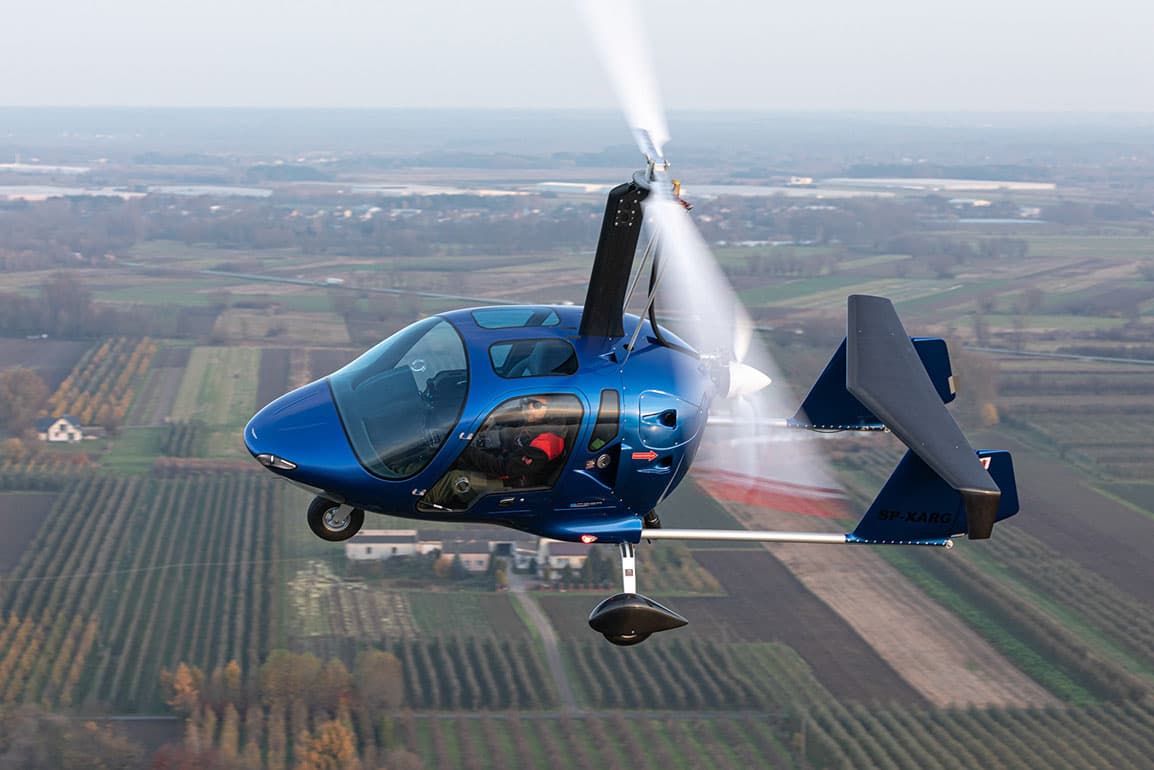
A gyrocopter has a rotor above it, like a helicopter, and a propeller behind it, like an aeroplane. What makes it neither is that the engine does not turn the rotor - the air does. The propeller pushes the aircraft forward, air flows up through the rotor from below and keeps it spinning, and that spinning makes the lift. The word for it is autorotation, and it is what a helicopter falls back on when its engine stops - only in a gyroplane it is the normal state of flight rather than an emergency. "Gyrocopter", "gyroplane" and "autogyro" all mean this aircraft; the CAA calls it a gyroplane.
Written by Argo Aero UK, the United Kingdom dealer for Manufaktura Lotnicza, who sell them - so read the recommendations knowing that, and note that the physics above is not ours to spin.
The short answer
Put another way: a helicopter's engine drives its rotor; a gyroplane's does not. Everything else - why it cannot stall, why it lands slowly and steeply, why it costs a fraction of a helicopter - follows from that one difference.
The engine drives the propeller, which pushes the aircraft forward. As it moves, air flows up through the rotor disc and spins it, and the spinning rotor makes the lift. Nothing connects the engine to the rotor at all. That state - a rotor turned by airflow rather than by power - is called autorotation, and a gyrocopter is in it from the moment it leaves the ground until the moment it stops.
Almost every question people ask about these aircraft is answered by that one sentence. Here is how.
Why it cannot stall
An aeroplane stalls when the wing is asked for more lift than the air flowing over it can supply. It is the single most common way light aircraft are lost, and every fixed-wing pilot spends hours learning to recognise and recover from it.
A gyrocopter has no fixed wing to stall. Its rotor is spun by air passing through it, so as long as the aircraft is moving through the air the rotor turns and makes lift - including when it is descending steeply, and including with the engine off. Fly it too slowly and it does not drop out of the sky; it simply descends, still under control. That is the largest single safety difference between a gyroplane and a light aeroplane, and we go into the rest of it here.
Why an engine failure is different
In a helicopter the engine turns the rotor, so losing the engine means losing rotor speed. The pilot has a few seconds to lower the collective and enter autorotation before the rotor slows below the point of recovery. It is a trained, time-critical action.
In a gyrocopter there is nothing to enter. The rotor was never driven, so an engine failure takes away thrust and leaves lift exactly where it was. The aircraft becomes a glider with a rotor, descending at a steep but controlled angle, and you fly it to a landing. The rotor above your head does not notice that the engine has stopped.
What it cannot do
It cannot hover. The rotor needs air moving through it, and in a hover there is none. In a strong headwind a gyroplane can be held almost stationary over the ground, which looks like hovering and is not. If your flying genuinely requires a hover, you need a helicopter, and you will pay for it twice - once at purchase and again every hour you fly. The full comparison is here.
| Aircraft | What turns the rotor | What follows from it |
|---|---|---|
| Aeroplane | Fixed wing, engine drives a propeller | Needs speed across the wing to fly. Below that speed the wing stalls. |
| Helicopter | Engine drives the rotor | Can hover. If the engine stops the pilot must enter autorotation, and quickly. |
| Gyrocopter | Air drives the rotor, engine drives a propeller | Always in autorotation. Cannot stall. Cannot hover in still air. |
Gyrocopter, gyroplane, autogyro - which is it?
All the same aircraft. Gyroplane is the word UK regulation uses, and the licence is the PPL(G) for that reason. Gyrocopter is what almost everybody types into a search box. Autogyro is the original term, from the Spanish engineer Juan de la Cierva who flew the first successful one in 1923 - and it is also the name of a large manufacturer today, which is why the word does double duty. You will also meet rotaplane in older documents. Nobody is describing anything different.
What it is like to land one
This is the part that surprises people. Flown properly a gyroplane touches down almost on a single spot and rolls a couple of metres - onto a farm strip, a beach, or two metres of runway. Thirty-five seconds, filmed at our partner school. The certified figure at full weight is 60 metres, and how much runway a gyrocopter needs has the take-off side of it too.
What one costs
A new two-seat machine starts at £125,000 and a fully equipped touring aircraft at £165,000, both excluding taxes and delivery. Running costs are the part that surprises people used to aviation prices: about £35 an hour in fuel, oil and scheduled servicing, because these aircraft run on ordinary unleaded petrol rather than avgas. A full tank gives a little over five hours and about 470 miles.
What you need to fly one
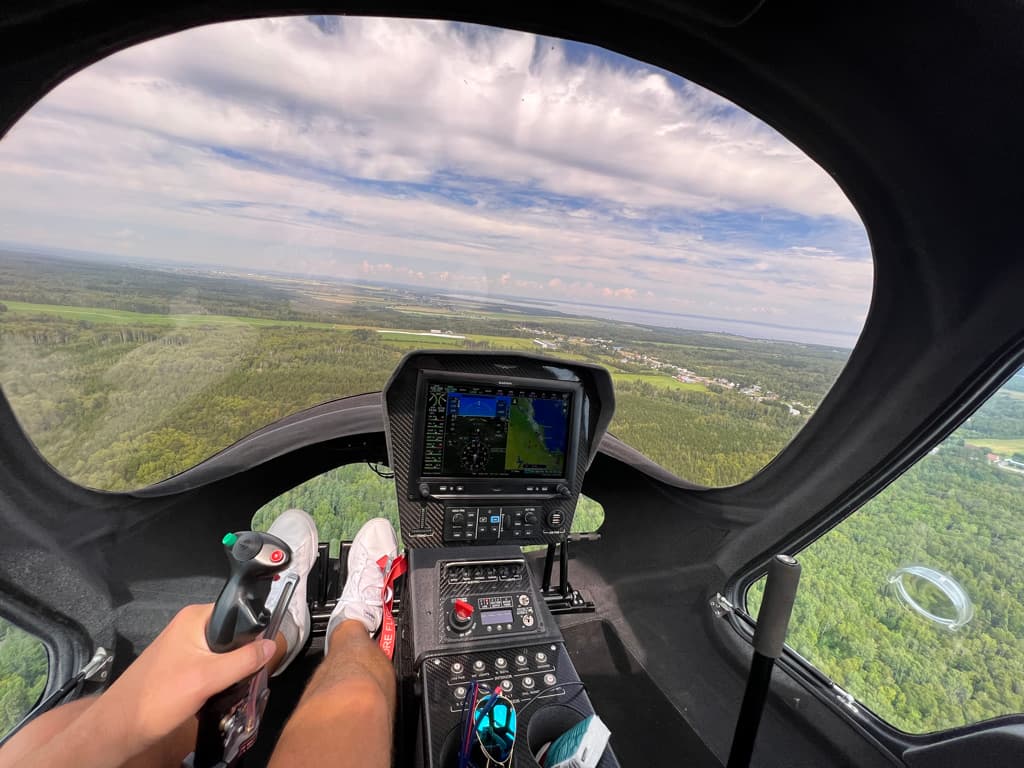
In the UK, the PPL(G). The CAA minimum is 40 hours of supervised flight training - of which 15 dual and 10 solo must be flown in gyroplanes - five written papers at a 75% pass mark, a radio licence and a flight test. Flown intensively that is about four weeks in the air; at British weekends it usually takes six months to a year, because the weather cancels more lessons than anything else.
If you want to see exactly what you would fly, the full syllabus is published here - all 38 exercises, stage by stage - and what the licence costs is set out line by line.
Is it the aircraft for you?
A gyrocopter suits someone who wants to go places in a small, cheap-to-run aircraft that is forgiving in rough air, gets in and out of short strips, and cannot stall. It does not suit someone who needs to hover, carry four people, or fly above the weather. Those are honest limits and worth knowing before you spend a weekend finding out. If the aircraft you are really weighing it against is a microlight, that comparison turns on flyable days rather than on hovering.
One assumption worth correcting while you are here: if the picture in your head is an open cockpit, a helmet and goggles, that is most gyroplanes but not all of them. The fully enclosed ones have heating, leather and a glass panel, and the factory's next idea is to put them on floats and on skis.
The quickest way to know is to sit in one. See the gyrocopters for sale in the UK, who sells them and what a gyrocopter costs, or ask us anything - including the questions that make us look bad, which we would rather answer now than after you have bought something.
If you are thinking of buying one
The two questions that come next, answered at length: which gyrocopter to buy sets the AutoGyro Cavalon and the Magni M24 against our own ARGON GTL on each manufacturer's published figures, and buying a used gyrocopter in the UK covers what the second-hand market actually holds and what to check before parting with the money.
Frequently asked questions
What is a gyrocopter?
An aircraft with a free-spinning rotor above it and a propeller behind it. The engine drives only the propeller, which pushes the aircraft forward; the air flowing up through the rotor spins it, and the spinning rotor produces lift. Because the rotor is never driven by the engine, it is turning in autorotation from takeoff to landing.
What is the difference between a gyroplane and a gyrocopter?
Yes. Gyrocopter, gyroplane, autogyro and rotaplane all describe the same aircraft. UK regulation and the licence use gyroplane; gyrocopter is what most people type into a search box. Autogyro is also a manufacturer's name, which adds to the confusion.
What are the disadvantages of gyrocopters?
Four, said plainly. It is slower than an aeroplane of the same power - about 81 knots against 155 for a Sling on the same engine. It flies day VFR only, so it will not take you anywhere in weather. It carries two people, not four. And the rotor has to be handled correctly on the ground in wind, which is a skill rather than a hazard but has to be learned. What you get in exchange is that it cannot stall, it needs a few dozen metres of grass instead of a runway, and it costs about £30 an hour.
How much do gyrocopters cost?
New from the factory, an ARGON 915 iS starts at £125,000 and an ARGON GTL at £165,000, both with a carbon fibre enclosed cabin, Garmin glass and an autopilot. Running costs are about £30 an hour in fuel, oil and scheduled servicing, on unleaded petrol rather than avgas. Older second-hand machines sell for a great deal less.
Can a gyrocopter stall?
No. A stall happens when a fixed wing is asked for more lift than the airflow over it can provide. A gyrocopter's rotor is turned by the air passing through it, so as long as the aircraft is moving through the air - including descending with the engine off - the rotor keeps turning and keeps making lift. That is the single largest safety difference from a light aeroplane.
What happens if a gyrocopter engine fails?
You lose thrust, not lift. The rotor was never driven by the engine, so nothing changes above your head: the aircraft becomes a glider with a rotor and you fly a descent to a landing. There is no transition to enter and no rotor speed to preserve, which is what makes the failure less demanding than the equivalent in a helicopter.
Can a gyrocopter hover?
Not in still air. The rotor needs airflow through it, and in a hover there is none. In a strong enough headwind a gyroplane can be flown almost stationary over the ground, but it is not a hovering aircraft. If you need to hover, you need a helicopter - and you pay for it in purchase price and in running cost.
Do you need a licence to fly a gyrocopter in the UK?
Yes, the PPL(G). The CAA minimum is 40 hours of supervised training, of which 15 dual and 10 solo must be flown in gyroplanes, plus five written examinations at a 75% pass mark, a radio licence and a flight test.
Two figures people ask for next: how high one flies and how long it stays up.