

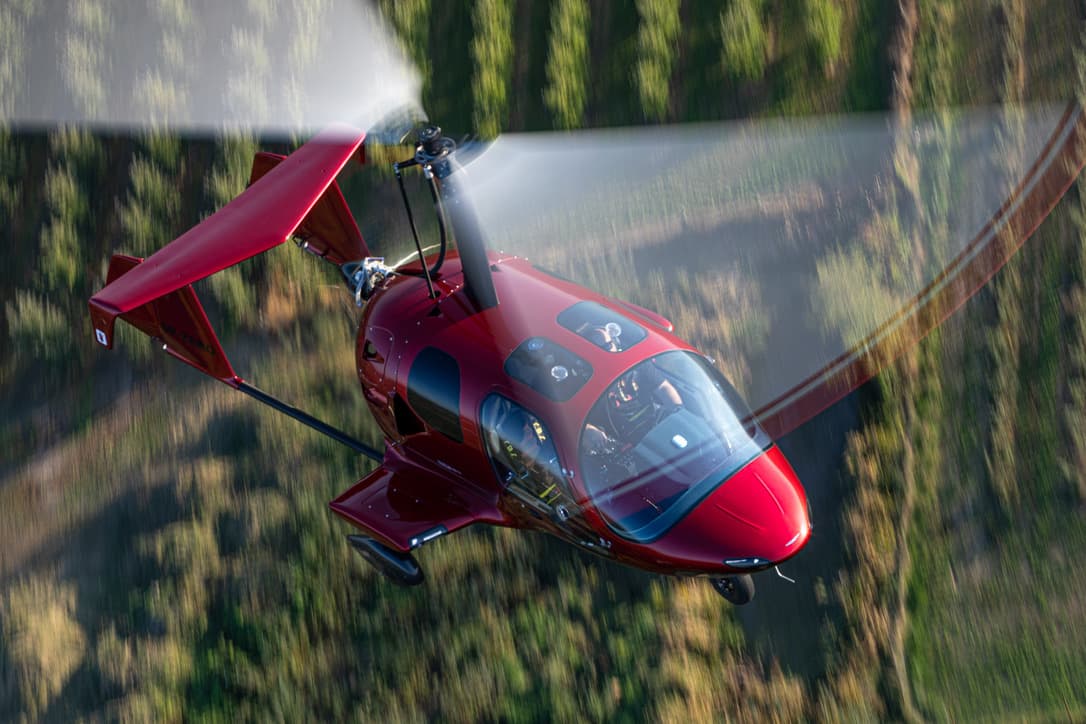
How Long Can a Gyrocopter Stay in the Air?
Five hours, worked from the flight manual rather than the brochure
The short answer
A little over five hours, and about 470 miles, in an ARGON GTL. That is not a marketing figure - it is arithmetic on two numbers out of the flight manual, and you can check it yourself.
| Fuel on board | 120 litres, in two tanks of 60 |
|---|---|
| Non-extractable | 6 litres - it stays in the tanks |
| Usable | 116 litres |
| Cruise burn | 23 litres an hour at 150 km/h TAS, 3,000 ft |
| Endurance, dry tanks | 5 hours 2 minutes |
| Still-air range, dry tanks | About 470 miles |
116 divided by 23 is 5.04 hours. At 150 km/h that is 757 km, or about 470 miles. With external tanks fitted the GTL will go up to 620 miles, which is where the 1,000 km figure you may have seen comes from - it belongs to the aircraft with the extra tanks, not the standard one.
Now the honest version
Nobody flies to dry tanks. Two things eat into that 470 miles before you have left the ground.
The first is the reserve any sensible pilot carries. The second is specific to this aircraft and it is in the takeoff checklist: there must be at least 20 litres in the tanks for takeoff, and below that level the electronic gauge may under-read. Treat 20 litres as the fuel you land with, not the fuel you use.
| How you plan it | In the air | Still-air range |
|---|---|---|
| Everything usable, no reserve | 5 h 02 | 470 miles |
| Half an hour in reserve | 4 h 32 | 423 miles |
| Landing on the 20-litre minimum | 4 h 10 | 390 miles |
390 miles is the number to plan against. Still air, no headwind, landing legal and unhurried.
What 390 miles buys you
London to Edinburgh is about 330 miles in a straight line. That is inside the planning figure, in one go, in a two-seat aircraft you can keep at a farm strip. London to Paris is 210 miles - there and back is 420, so that is a trip with a fuel stop, not a heroic one.
Land's End to John o' Groats is around 600 miles, so no, not in a single hop on standard tanks. With external tanks and 620 miles of range, on a still day, it becomes a conversation. And an ARGON has already answered the bigger question: the Fly The North expedition covered 16,000 km from Europe to the USA, which is what these numbers look like when you string enough of them together.
The trade nobody mentions: fuel weighs something
120 litres of petrol is about 86 kg. The GTL has a 600 kg maximum take-off weight. Full tanks, two adults and a cubic metre of luggage do not all go in at once - on this aircraft or on any other in the class.
That sounds like a limitation and is really a choice. Five hours of fuel is for the day you are crossing a country. On a Sunday hop you carry two hours, leave 60 kg on the ground and take the second person and the bags instead. The aircraft that can do both is the one worth owning; the mistake is assuming it does both simultaneously.
Against a helicopter
The ARGO AH-22 standard specification gives 2.6 hours including a 10% reserve, and 320 km of range. Half the endurance of the gyroplane, on a higher fuel burn.
That is not a fault in the helicopter, it is the price of the hover. A helicopter spends power holding itself up; a gyroplane lets the air do it and spends its fuel going somewhere. If your flying is journeys, the gyro wins on endurance and on cost. If you need to arrive where there is no runway at all, you pay the two hours. The full comparison is here.
Five hours in the seat
Endurance is only worth having if the cabin is worth sitting in. This is the view from the left seat of an ARGON at sunset - glass panel live, water and farmland sliding past under the glazing.
What goes in the tanks matters as much as how much: these aircraft run on ordinary unleaded, not avgas, which is why five hours of flying costs what it does. The rest of the running costs are in the GTL price guide.
The other half of the same question: how high a gyrocopter can fly - four ceilings, and the lowest one decides.
Frequently asked questions
How long can a gyrocopter fly?
A little over five hours in an ARGON GTL. The flight manual gives 116 usable litres and a cruise burn of 23 litres an hour, which is 5 hours 2 minutes to dry tanks. Plan on about 4 hours 10 minutes if you intend to land with the 20 litres the takeoff checklist calls for.
How far can a gyrocopter fly?
About 470 miles in still air on the ARGON GTL's standard tanks, and up to 620 miles with external tanks fitted. A realistic planning figure with fuel in reserve is nearer 390 miles - still London to Edinburgh with something in hand.
How fast can a gyrocopter fly?
It is a sum to do, not an assumption to make. 120 litres of petrol weighs about 86 kg, and the GTL has a 600 kg maximum take-off weight. Full tanks, two adults and luggage will not all fit at once on any aircraft in this class - you trade fuel for payload, and on a two-hour trip you simply do not need five hours of fuel aboard.
Does a gyrocopter use more fuel than a helicopter?
Considerably less. An ARGON burns 23 litres an hour at cruise; the ARGO AH-22 helicopter burns 25 and the AH-24 about 35. The gyroplane also flies further on what it carries, because it is not spending power to hold itself up.
How slow can a gyrocopter fly?
The AH-22 standard specification gives a maximum flight duration of 2.6 hours including a 10% fuel reserve, and a maximum range of 320 km. A helicopter pays for its hover in endurance - that is the trade.