

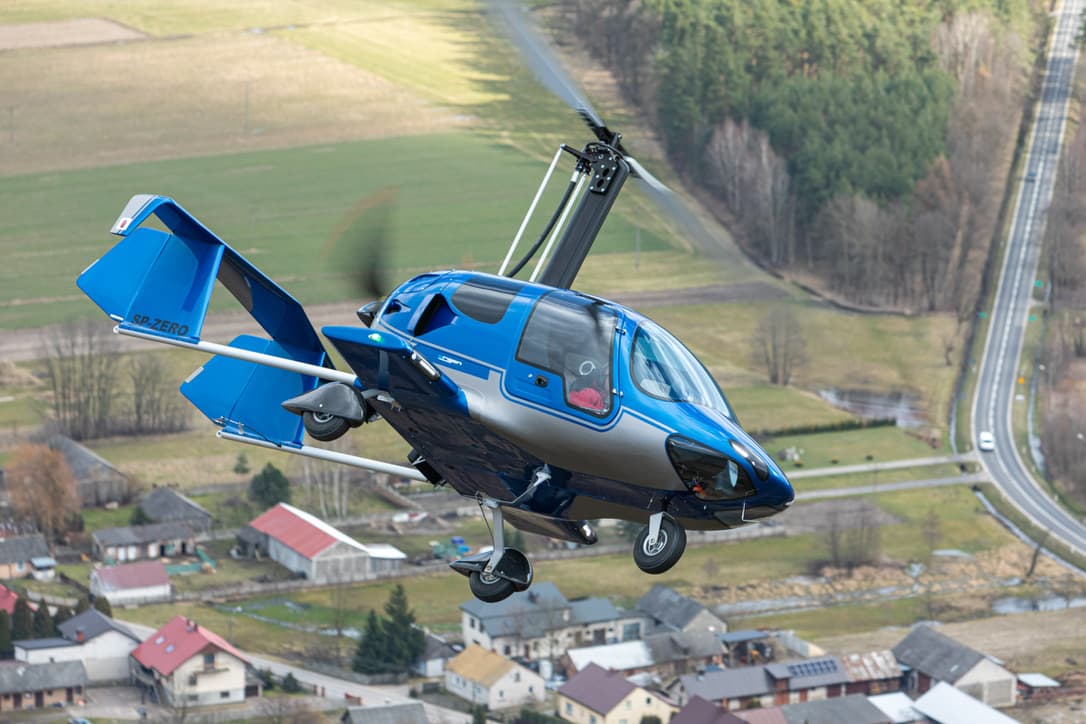
How High Can a Gyrocopter Fly?
Four different ceilings, and the one that decides your flight is the lowest
About 18,000 ft physically, 10,000 ft verified, and 2,000 to 5,000 ft in practice on a British afternoon. The ARGON GTL flight manual gives a physical service ceiling of FL180 and states that the service ceiling is verified up to FL100. What keeps a real flight far below both is not the aircraft: it is where controlled airspace begins, the fact that no gyroplane carries oxygen, and the cold.
The figures below are from the ARGON GTL flight manual, issue 1 of 29 November 2024, which we host in full so you can check them - sections 2.8 and 5.6. The legal limits are UK air law. Set out by Argo Aero UK, the United Kingdom dealer for Manufaktura Lotnicza.
The four ceilings
People asking this question usually have one number in mind. There are four, and they descend in that order - so the answer you can use is the last one.
1. What the aircraft can physically reach
FL180 - about 18,000 ft - The flight manual calls this the physical service ceiling. It is what the rotor and engine are capable of, not a height you are cleared to use.
2. What the manufacturer has verified
FL100 - about 10,000 ft - Section 2.8 puts it plainly: the service ceiling is verified up to FL100. Beyond that the aircraft has not been flight-tested, so this is the real operating ceiling.
3. Where the oxygen rules begin
10,000 ft, then 13,000 ft - Above 10,000 ft you need supplemental oxygen for any period longer than 30 minutes, and above 13,000 ft continuously. A gyroplane carries no oxygen system, so this is a hard stop rather than an inconvenience.
4. Where a British flight actually tops out
Usually 2,000 to 5,000 ft - Not a limit of the aircraft. It is where controlled airspace starts over much of the country, and entering it needs a clearance you may or may not get.
The number that agrees from two directions
Worth noticing: 10,000 ft appears twice. It is where the manufacturer stopped flight-testing, and it is where the oxygen rule starts to bite - supplemental oxygen for any period over 30 minutes between 10,000 and 13,000 ft, and continuously above 13,000.
That is a coincidence of two entirely separate authorities landing on the same figure, and it makes the answer unusually clean: a gyroplane's useful ceiling is 10,000 ft, and there is no sensible argument for going higher in one.
How long it takes to get there
The ARGON GTL climbs at 7 m/s - about 1,400 ft per minute at sea level, at a best-climb speed of 110 km/h IAS (60 knots). That is a strong figure for a light aircraft.
It does not mean 10,000 ft in seven minutes. Climb rate falls with height and in air warmer than standard - the manual gives a correction diagram for exactly that - so the real number is considerably longer. And in the standard atmosphere the temperature falls about 2 °C for every 1,000 ft, so what you are wearing decides the question long before the aircraft does.
The limit that actually matters is the low one
Nobody asks it, and it governs almost every flight. You may not fly closer than 500 ft to any person, vessel, vehicle or structure without written CAA permission. Over a congested area of a city, town or settlement, not below 1,000 ft above the highest fixed obstacle within 600 metres.
A gyroplane gets no lighter treatment for being small, slow and quiet. If you are picturing yourself following a beach at a hundred feet, that picture is of an offence rather than a flight.
Where the aircraft is actually good
Between about 500 and 2,000 ft, which is not a compromise - it is the point of the thing. A gyroplane has a rotor above and a propeller behind and nothing between you and the ground: no wing, no strut, no doorframe. It flies low and slowly, which is what looking at something requires.
Height is what you buy when you need to cross something. Our own coastal flights run low along the cliffs for the same reason, and it is why the comparison with a helicopter turns on the hover rather than on altitude - both aircraft run out of reasons to climb long before they run out of ability.
Frequently asked questions
How high can a gyrocopter fly?
A modern two-seat gyroplane reaches around 18,000 ft physically and is verified to 10,000 ft. The ARGON GTL flight manual gives a physical service ceiling of FL180 and states that the service ceiling is verified up to FL100. In practice a UK flight rarely goes above 2,000 to 5,000 ft, because that is where controlled airspace begins and because no gyroplane carries oxygen - and above 10,000 ft supplemental oxygen is required for any period over 30 minutes.
What is the service ceiling of a gyroplane?
For the ARGON GTL, FL100 - about 10,000 ft - which is the height the manufacturer has flight-tested and verified. The flight manual separately gives FL180 as the physical service ceiling, meaning what the aircraft can reach rather than what it is cleared to do. The two numbers are not interchangeable, and the lower one is the one that governs a flight.
How fast does a gyroplane climb?
About 1,400 ft per minute at sea level in the ARGON GTL, at a best-climb speed of 110 km/h IAS (60 knots). Climb rate falls as you go up and in air warmer than standard, so reaching the verified ceiling takes considerably longer than dividing one figure by the other suggests.
How low can a gyrocopter legally fly in the UK?
Not closer than 500 ft to any person, vessel, vehicle or structure, without written CAA permission. Over a congested area of a city, town or settlement, not below 1,000 ft above the highest fixed obstacle within a horizontal radius of 600 metres. Those rules apply to a gyroplane exactly as they apply to any other aircraft - there is no lighter treatment for being small and slow.
Do you need oxygen in a gyroplane?
Not at the heights anyone actually flies them. The rule for a non-commercial flight is supplemental oxygen for any period over 30 minutes between 10,000 and 13,000 ft, and continuously above 13,000 ft. Since gyroplanes carry no oxygen system and are verified only to 10,000 ft anyway, the two limits meet at the same number and neither is reached on a normal flight.
Can a gyroplane fly higher than a helicopter?
Height is the wrong question to separate them on. Our own ARGO AH helicopter publishes a maximum altitude of 15,000 ft against the gyroplane's FL180 physical and FL100 verified, but neither aircraft is limited by rotor performance in real flying - air law, the absence of oxygen and the cold stop you first. The difference that matters is the hover, which a helicopter has and a gyroplane does not, and it is the reason a helicopter licence costs about £30,000 more.