

Things to Do in the Algarve: See It From the Air
Half an hour that outlasts the fortnight
You will have the beach days. They are the reason you came, and they are very good beach days. But somewhere around the fifth one, usually when somebody suggests another boat trip to the same cave, the question arrives: is there anything here we have not done?
There is. You can go and look at the whole coast from a thousand feet, in a two-seat aircraft with the visibility of a helicopter and none of the noise, and be back before lunch.
What is actually underneath you
This coast is unusually good from the air because everything worth seeing is on one line and none of it is far apart. Working west to east - and with one caveat first: a half hour covers the western end, Sagres to about Portimão. Carvoeiro, Benagil and Albufeira want the full hour, and Tavira is a long way east even by air. Say what you most want to see when you book and the route gets built round it:
Cabo de São Vicente and Sagres
The south-western corner of Europe - a lighthouse on cliffs above open ocean and a fortress on a windswept peninsula. For centuries this was where the known map stopped. The westernmost thing you can fly to, and the emptiest.
Praia da Luz and the western coves
The line of coves west of Lagos, each one tucked into its own break in the cliff. The pattern only makes sense from above - from the ground each looks like the only one.
Ponta da Piedade, Lagos
The headland where the Atlantic has cut the cliffs into golden stacks, arches and grottos. From the clifftop you see the top of it and from a boat you see it from the water; from the air you see the shape of the whole thing at once, and the water through the arches.
Alvor
The surprise of the flight for most people. The estuary behind the town is a maze of sandbanks, channels and salt marsh that shifts with the tide, and it is completely invisible from the road - you have to be above it before it becomes a landscape rather than a car park and a beach.
Portimão and the Algarve International Circuit
Praia da Rocha's rock stacks below the town, and inland the track that hosted the Formula 1 Portuguese Grand Prix. Following the racing line from above - every crest, every blind corner, the elevation change television never conveys - is the part people talk about afterwards.
Carvoeiro and Algar Seco
The cliff town with the boardwalk, and just east of it the eroded rock formations at Algar Seco: arches, chimneys and collapsed caves. The boardwalk crowds are a line of dots; the geology underneath them is the actual sight.
Benagil
The sea cave with the hole in its roof, the one from every photograph of the Algarve. Boats queue to get inside it. From the air you look straight down through the roof, which is the view the photographs cannot take.
Armação de Pêra and Praia da Marinha
A long open beach after miles of coves, and immediately west of it Praia da Marinha - the double arch that appears on every poster of Portugal, and which from above is plainly the roof of two collapsed caves rather than a sculpture.
Albufeira
The old town folded into a cleft in the cliff, with the marina painted in blocks of colour beside it. The contrast between the white old town and the resort strip behind it is the clearest thing from the air about how this coast changed in fifty years.
Vilamoura
A planned marina, geometric and deliberate, dropped into a coastline that is otherwise entirely accidental. Worth seeing precisely because it looks like nothing else here.
Silves, inland
The red sandstone castle above the town, Moorish and enormous, in a valley of orange groves. On the ground it is a castle; from the air it is obviously a fortress commanding a river, which is why it is there.
Tavira and the salt pans
Far east, and a different Algarve - a barrier island of sand offshore, and behind the town a grid of salt pans that go pink and white and rust depending on the season. Geometry laid over a lagoon.
Monchique and Foia
The mountains behind the coast, and the reason the weather here is what it is. Foia is the highest point in the Algarve; the ridge is what keeps the cold north-westerlies off the beaches, and why the coast takes 450 to 550 mm of rain a year against 900 to 1,200 in the hills.
The Formula 1 circuit, from above
This is the one nobody expects. The Algarve International Circuit at Portimao is a proper Grand Prix track cut into rolling hills, and its whole character - the blind crests, the elevation change that television never conveys - only reads properly from the air. Following the racing line at a few hundred feet is the part of the flight people describe to other people afterwards.
What it is actually like
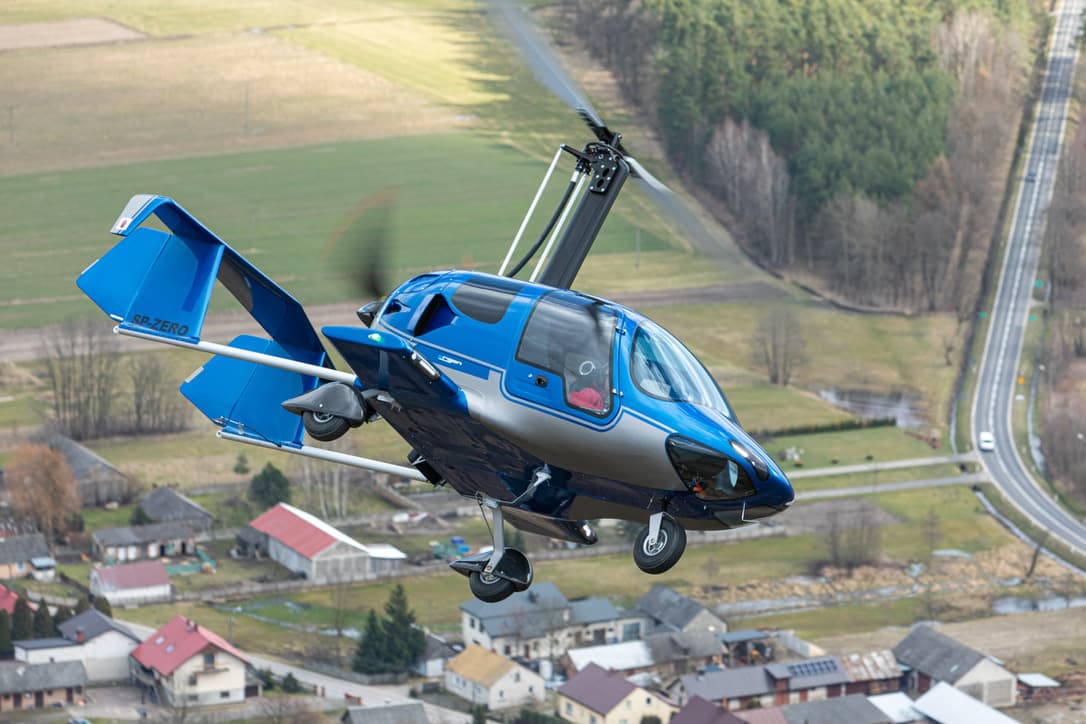
A gyroplane flies low and slowly, which is exactly what you want when the point is to look at something. This is the view from the left seat at sunset - the panel live, water and farmland sliding past under the glazing.
You sit beside an instructor who flies it. There is no licence to hold, no experience needed and no kit to bring - people fly in what they arrived in, and the Algarve climate makes that the right answer all year. Flights run as a half hour or a full hour from an airfield near Lagos, and whoever came with you can watch the whole thing from the ground.
If the idea makes you uneasy, the honest reassurance is mechanical rather than soothing: a gyroplane's rotor is turned by the air flowing through it and not by the engine, so it cannot stall, and the same rotor shrugs off the bumps that make a small aeroplane unpleasant on a warm afternoon.
And if you come down wanting to fly it yourself
A fair number of people do. The useful part: an experience flight with an instructor is logged, and counts towards the hours for a licence. So the half hour you took as a holiday outing is not a novelty purchase - it is the first entry in a logbook, whether or not you ever add a second.
If you do add a second, the reason people fly here rather than at home is the weather. The UK gyroplane licence takes 40 hours of training. Flown at British weekends that usually stretches to six months or a year because the weather cancels more lessons than everything else. Out here it is about four weeks of flying, and it splits neatly into two fortnights - which is to say, two holidays. How the course works and what it costs are both set out in full.
One thing to know before you plan that far: training in Portugal requires a valid Class 2 medical certificate, and it has to be arranged before you travel. A sightseeing flight does not.
Practical notes
Flights go from near Lagos, and Praia da Luz a few kilometres west is the easiest base to stay in. Book ahead rather than on the day: there is one aircraft and one instructor, and August fills. Mornings are usually the better slot, and the light late in the day is the better photograph. If you are weighing this against a helicopter tour, the two are compared side by side. There is also a list of the unusual things to do here that are not a beach - and what else there is to do in Lagos is a separate list.
Frequently asked questions
Is there a helicopter tour in the Algarve?
There are helicopter rides in the Algarve, and there is also this: a coastal flight in a two-seat gyroplane from an airfield near Lagos, flown with an instructor as a half hour or a full hour. It sits lower and slower than a helicopter, has no wing in the way of the view, and costs a fraction of the hourly rate. No licence, no experience and no special clothing are needed.
What will I see on a coastal flight?
Working west to east: the lighthouse and fortress at Cabo de Sao Vicente and Sagres, the coves around Praia da Luz, Ponta da Piedade off Lagos, the hidden estuary behind Alvor, Praia da Rocha and the Formula 1 circuit at Portimao, the rock formations at Carvoeiro and Algar Seco, the Benagil sea cave from directly above, the double arch at Praia da Marinha, the old town and marina at Albufeira, the planned marina at Vilamoura, the Moorish castle inland at Silves, and the salt pans behind Tavira. Inland, the Monchique ridge that shelters the whole coast. A half hour covers the western end; the eastern towns want the full hour.
Is a gyroplane flight frightening?
Less than most people expect. A gyroplane's rotor is turned by the airflow rather than by the engine, so it cannot stall, and its rotor disc cuts through the bumps that make a small aeroplane uncomfortable. It flies low and slowly, which is exactly what you want when the point is to look at something.
Does the flight count towards a pilot licence?
An experience flight flown with an instructor is logged and counts towards the hours for the UK Gyroplane Pilot Licence. So if you enjoy it, the half hour you flew as a holiday outing is already part of a licence should you decide to go further.
What is the best time of year to fly in the Algarve?
Almost any of it. The coast gets 450 to 550 mm of rain a year against 900 to 1,200 in the hills behind, and the Monchique range blocks the cold north-westerlies, so flyable days run right through the year rather than clustering in summer.