

Why the Algarve: The Weather, the Wind and the Week Around It
What makes it the sensible place to learn - and the enjoyable one
There is a practical reason we send students to the Algarve and a pleasant one, and it would be dishonest to pretend the second does not matter. The practical reason is that you cannot learn to fly on days you do not fly. The pleasant one is that the week around the flying is a holiday your family would have chosen anyway. Both are worth setting out properly.
The mountains make the weather
The Algarve is not simply “the south”. It is sheltered, and by something you can see from the air. Two ranges - the Serra de Monchique and the Serra do Caldeirão - run along the northern edge of the region and stand as a barrier to the cold north and north-westerly airflow that sweeps the rest of Iberia. What reaches the coast has been softened.
The same barrier takes the rain out of the sky before it arrives. Up in the hills the annual total runs to 900-1,200 mm; down on the coastal strip where the airfield sits it is roughly 450-550 mm. That gap is the whole argument. It is why a training diary here fills up at a pace a British one cannot match, and why the intensive course measures itself in weeks rather than the six months to a year a weather-bound UK schedule usually takes.
About the wind - the honest version
There is wind. This is the Atlantic coast and it would be silly to claim otherwise. But wind by itself is rarely what cancels a lesson, and it is worth being clear about why, because the fear of it puts people off for no good reason.
A gyroplane is unusually relaxed about moving air. Its rotor is always in autorotation, driven by the airflow rather than the engine, and that gives it a gust tolerance a light fixed-wing aircraft simply does not have - one of the reasons gyroplanes are among the most forgiving aircraft to fly. A breeze that would have a microlight tied down is, for a gyro, an ordinary Tuesday. On the ground it is doing you a favour too: it is the reason the beach is bearable in August.
How the flying day is shaped
Not by thermals. That is worth stating plainly because it is the thing people expect us to say, and our instructor is blunt about it: the flying there is not affected by them. A gyroplane's rotor is in autorotation from the moment it turns, and rough air troubles it far less than it troubles a light aeroplane.
What shapes the day is you. We fly two hours back to back, in one block, and then the rest of the day is yours. Not split across a morning and an evening, and not sitting out in the midday sun waiting for a second slot. Two solid hours is about what anyone absorbs in a day of concentrated instruction - and it means whoever travelled with you gets a holiday rather than a week of waiting at an airfield.
Not committing to a course yet? You can simply go up and look at the coast for half an hour, which is a good deal more interesting than a fifth beach day - and the flight is logged either way.
The week around the flying
A licence course is not a fortnight in a classroom. You fly early, you fly late, and the hours in between are yours. Everything below is within reach of a morning or an afternoon from Lagos:
| Ponta da Piedade | The headland on Lagos's doorstep, where the Atlantic has carved the cliffs into golden sea stacks, arches and grottos. A boardwalk runs along the top and the walk from town takes about forty minutes. Go for sunset. |
|---|---|
| Cabo de São Vicente and Sagres | The south-western corner of Europe: a lighthouse on cliffs above open ocean, a fortress on a windswept peninsula, and the sense of standing at the end of the map. Half an hour west of Lagos. |
| Silves | A red sandstone Moorish castle above a river town, and the clearest surviving picture of who ruled this coast before Portugal did. |
| Monchique and Fóia | The mountains that make the weather. Fóia is the highest point in the Algarve, and the road up passes Caldas de Monchique, a spa village built around thermal springs. |
| Benagil | The sea cave with a hole in its roof - the one from every photograph of the Algarve. Reached by boat from the coast east of Portimão. |
| Ria Formosa | The lagoon and barrier islands behind Faro: salt pans, flamingos and sandbank beaches you reach by ferry. Convenient on your arrival or departure day. |
And one you can only do from our side of the fence: a flight tracing the Algarve Formula 1 circuit at Portimão from the air, which is part of the course itself.
Getting there, and getting about
Fly into Faro. It is one of the cheapest routes out of the UK, flown by most of the budget airlines, and the drive west to Lagos is straightforward.
Then take an electric hire car, and take it with a full charge. The arithmetic is unusually kind: a full charge bought at pickup runs to around £100, and you hand the car back empty - so that one payment is the whole of your motoring for the week, whatever you decide to go and see. No fuel stops, no topping up before you return it, no per-kilometre worry about driving out to Sagres on a whim. Charge policies do vary, so confirm yours at the point of booking.
Why the combination works
Learning to fly in Britain tends to be a solitary business conducted in poor weather over many months, and the people around you see very little of it beyond your absence on Saturdays. Here it is the opposite. You are up at first light doing the most interesting thing you have ever done, back for a late breakfast, out to a cliff or a castle in the afternoon, and flying again as the day cools. The licence gets finished because the weather lets it. The holiday happens because the timetable leaves room for it.
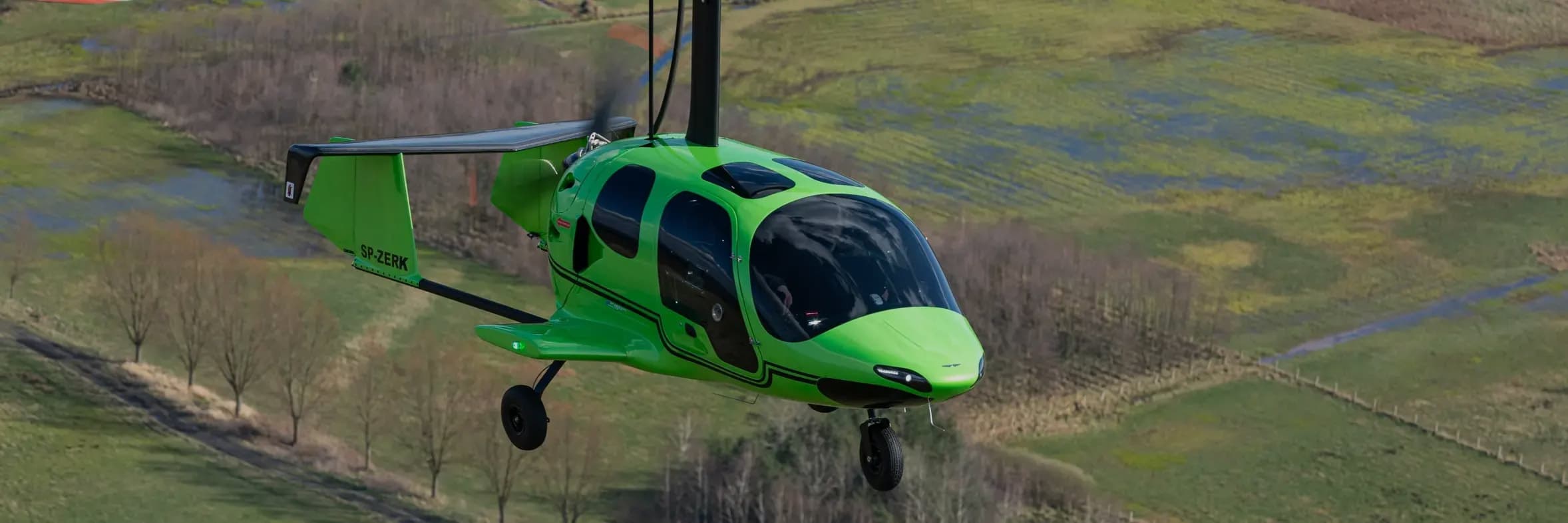
If you want the regulatory detail first - hours, exams, medical, flight test - it is all in our guide to the UK PPL(G), and the numbers are in what a gyroplane licence costs. Wondering what the aircraft is like to sit in? That is here.
The winter figures make the case better than anything else: five to six hours of sunshine a day in January, which is more than Britain averages in June.
Frequently asked questions
Why is the weather in the Algarve so reliable?
Geography. The Serra de Monchique and Serra do Caldeirão run along the northern edge of the region and act as a barrier to the cold north and north-westerly airflow, which is why the coast keeps a Mediterranean climate with mild winters. The mountains also take the rain: 900-1,200 mm a year falls at altitude against roughly 450-550 mm on the coast where we fly.
Is it too windy in the Algarve to fly?
No. There is wind - it is the Atlantic coast - but wind on its own is rarely what stops a training flight, and a gyroplane handles gusts better than most light aircraft because its rotor is always in autorotation. Thermals are not the constraint either: our instructor is blunt about it - the flying there is not affected by them.
Will turbulence make training unpleasant?
Less than you would expect. Thermals that would make a light fixed-wing aircraft uncomfortable are something a gyroplane takes in its stride - gust tolerance is one of the type's defining characteristics. We still plan around the middle of the day, because smooth air makes for better learning, not because the aircraft cannot cope.
How do I get there and get around?
Fly into Faro, which is one of the cheapest routes out of the UK and served by most budget airlines. Hire a car at the airport - an electric one is the sensible choice: a full charge taken at pickup costs in the region of £100 and you return the car empty, so that single payment is your entire motoring bill for the week. Confirm the charge policy when you book, as rental terms change.
Can my family come with me?
That is rather the point. Training runs in blocks with time either side, so the people travelling with you get a beach holiday while you fly, and you join them for the rest of the day. Accommodation can be arranged as part of the course.