

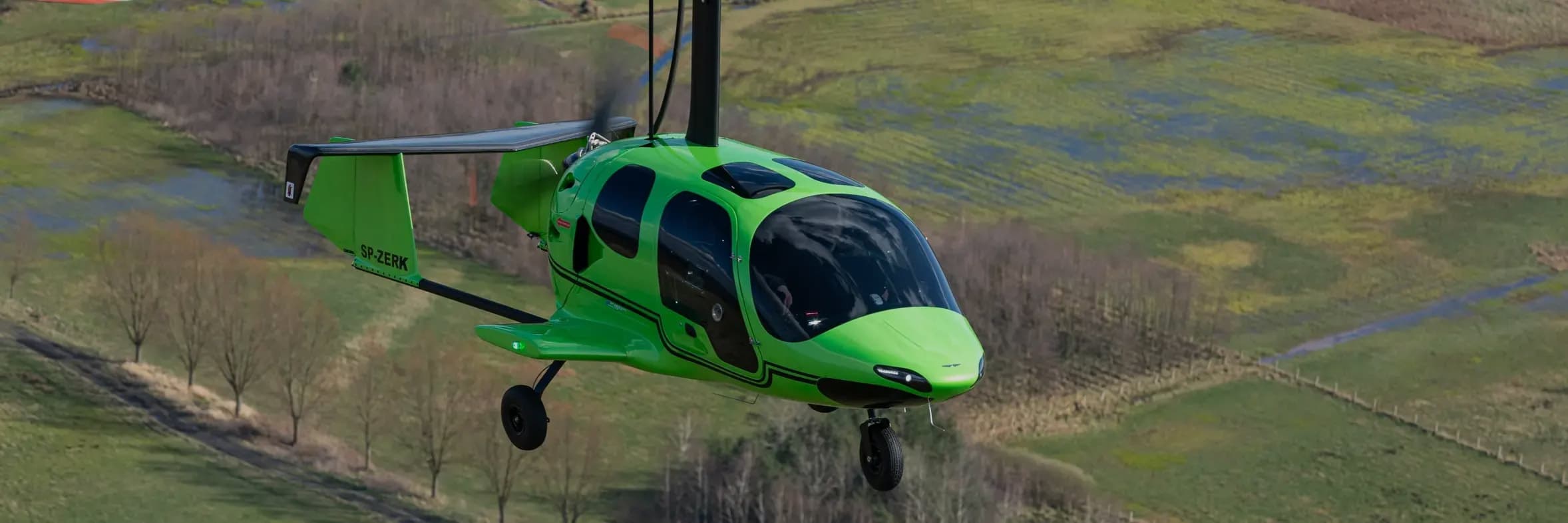
Gyrocopter Licence UK: How to Get Your PPL(G)
What it entails, how long it takes and what it costs
Yes - you need a licence to fly a gyrocopter in the UK, and there is no version of this where you do not. It is the Private Pilot Licence (Gyroplanes), better known as the PPL(G). This page answers the three questions everyone asks first - what the course actually involves, how long it takes and what it costs - and then walks the whole path, based on the requirements set by the Civil Aviation Authority in Standards Document 44. If you have arrived here simply wondering what one of these aircraft is, start with what a gyrocopter is and how it flies. If you want the flying itself broken down, our exercise-by-exercise guide to the PPL(G) syllabus lists all 38, stage by stage. And if the question is still the blunt one - do you need a licence at all - that is answered separately, including the one flight that is legal without one.
The short answer
- What it entails: 40 hours of flight training, five written examinations, two cross-country flights, a radio licence and a final flight test with a CAA examiner.
- If you already fly: the 40 hours may be made up of supervised training in any flying machine, so your existing hours count - but 15 dual and 10 solo must be flown in gyroplanes, so about 25 gyroplane hours is the realistic floor.
- How long: typically six months to a year training at weekends in the UK - or a matter of weeks flying intensively.
- What it costs: from £190 per flying hour - so from about £8,500 for the whole course, or about £5,600 if you already fly. The full price breakdown is here.
Step 1 - Try before you commit
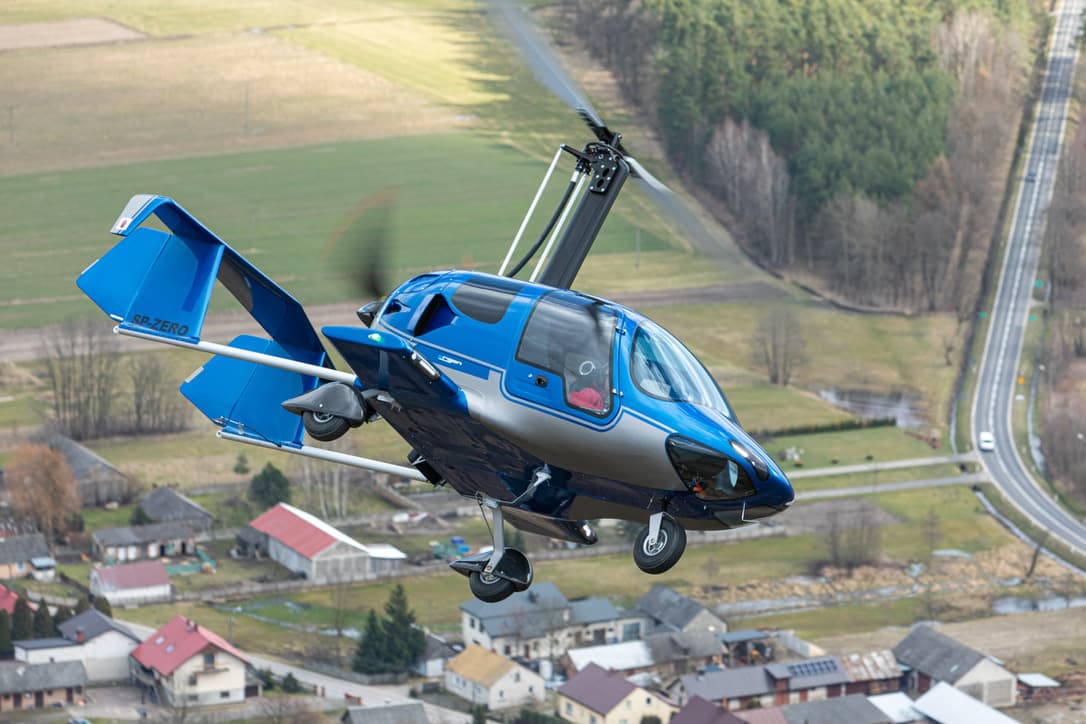
Before signing up for a full course, take a short hands-on flight. Argo Aero runs experience flights with a certified gyro instructor - a perfect way to find out whether gyrocopter flying is for you. Every experience flight you take with us is loggable towards the PPL(G), so your first taste of the sky already counts. You can book a slot directly from our live availability. Curious what the aircraft itself is like to sit in? We wrote about our training gyroplanes - enclosed cabin, no flying suit required.
Step 2 - What the course entails
These are the CAA minima. They are a floor, not a forecast: many students fly a few hours beyond them, and an instructor who signs you off at exactly 40 hours is signing off on your competence, not on a stopwatch.
| Total flight training | 40 hours minimum, dual and solo, supervised by an authorised instructor - in any flying machine, not only gyroplanes |
|---|---|
| Dual instruction in gyroplanes | 15 hours minimum |
| Solo flying in gyroplanes | 10 hours minimum |
| Of that solo, cross-country | 3 hours minimum, taking the aircraft more than 10 NM from the departure airfield |
| Cross-country exercises | 2 return flights, each landing at a different airfield and returning the same day, each route more than 25 NM and different from the other |
| Theory examinations | 5, pass mark 75% |
| Practical radio test | Required for the FRTOL |
The five theory papers are staggered through the course rather than sat in one sitting: Air Law before your first solo, then Meteorology, Navigation and Human Performance before you go cross-country, plus Gyroplane Technical before the flight test. The pass mark is 75%.
On the medical side there is no full medical certificate to obtain for the PPL(G): you can self-certify with a CAA Pilot Medical Declaration. If you already hold an NPPL medical declaration, a LAPL medical certificate or a Part-MED Class 1 or 2, that works too.
Step 3 - Where you are starting from
The single biggest variable in both cost and duration is what you already hold. Find your row:
| You are starting with | Minimum | What it means |
|---|---|---|
| No flying experience at all | 40 hours | The full course, all of it flown in gyroplanes. Most people are surprised how quickly the first hours go - a gyroplane is a forgiving machine to learn in. |
| Trial or experience flights already flown with an instructor | 40 hours | The minimum is unchanged, but the hours themselves are loggable - flights taken with us count towards the 40 from the very first one. |
| An existing licence - aeroplanes, microlights or helicopters | About 25 hours in gyroplanes | The 40 hours may be made up of supervised training in any flying machine, so what you have already flown counts towards the total. What cannot be substituted is the gyroplane time itself: 15 hours dual plus 10 hours solo. That floor of 25 gyroplane hours is where the widely quoted figure comes from. |
| A military flying background | Credits may apply | Standards Document 44 provides for credits towards a UK PPL(G) for military licence holders, in line with those available to UK PPL(A) and PPL(H) holders, where the training and exams passed can be shown to be equivalent. |
| Gyroplane hours flown abroad with another school | Creditable | They count if they are logged with the syllabus and exercise numbers and signed by a qualified instructor - and you then demonstrate each exercise to the UK standard to a UK instructor, who signs your logbook. Our own Algarve course is not in this category: it follows the CAA PPL(G) syllabus and counts towards your UK licence directly. |
| A lapsed licence, or hours flown years ago | Assessed individually | Bring your logbook. What counts is what you can demonstrate now, so the honest answer comes after a flight with an instructor, not before. |
A word on the widely quoted “25 hours”: it is not a discount granted for holding a licence. It is what is left once you notice that the 40 hours may be flown in any flying machine while the gyroplane minima - 15 dual and 10 solo - cannot be substituted by anything. Existing pilots should confirm their own credits with the school and the CAA before budgeting, because gyroplanes have flight dynamics of their own and the conversion is real training rather than a formality. If you are weighing the gyro against the machine you already fly, our comparison of gyrocopter versus helicopter is the honest version.
Step 4 - How long it takes
Training at weekends in the UK, the PPL(G) typically takes between six months and a year. The limiting factor is rarely the student and almost always the weather: a cancelled Saturday is a fortnight lost, because the next slot is two weekends away and that one clouds over too.
There are two ways to compress it. Fly more often than once a week - progress is not linear, and students who fly twice a week need fewer total hours because less time is spent re-learning. Or leave the weather behind entirely: our intensive fast-track programme in the Algarve runs from an exclusive ultralight airfield with flying weather all year and least two flights a day, turning months into weeks. That weather is not luck - the Serra de Monchique shelters the coast from the cold northerlies, which is also why the week around the flying makes a decent holiday.
Planning it around a job? We set out how fast the licence can realistically be done, and how to split it into two trips - including the three CAA clocks that decide what goes in which half.
To be clear about what that is: the Algarve course trains towards the UK PPL(G) itself. It follows the CAA syllabus and the hours are logged towards your licence, so it is a faster route to the same licence rather than a detour to a different one.
Worth knowing if you are comparing countries: France issues a gyroplane licence after roughly 15 hours where the UK asks for 40. We set out what those extra 25 hours actually buy you - and it is not paperwork.
Step 5 - What it costs
Gyroplane training is charged by the flying hour, which is why no honest school publishes a single course price: your total depends on the number of hours you fly, and that depends on your starting point and how often you can get airborne. What we can set out is everything the budget has to cover, so nothing arrives as a surprise:
- Dual instruction - the largest line by far, and the one that halves if you qualify for the 25-hour route.
- Supervised solo time - the aircraft is still chargeable when you are flying it alone.
- Five theory examinations and the study material behind them.
- The FRTOL radio licence, including its practical test.
- The CAA licence issue fee and the Pilot Medical Declaration (the declaration itself is a self-certification).
- Landing fees at the airfields you visit on your cross-country exercises.
We publish the actual numbers rather than hiding behind “it depends”: instruction starts at £190 per flying hour, which puts a full course from about £8,500, or about £5,600 if you already fly. The complete rate card sets out every line, including the £5,000 returnable bond held during solo training.
Tell us where you are starting from and we will put a written estimate against your actual number of hours - get in touch. And when you are budgeting beyond the licence, our guide to what a gyrocopter costs to buy and run covers the next chapter.
Step 6 - Cross-country flights and the flight test
Before your final test you must complete two cross-country exercises, each involving landings at other airfields - real navigation, real planning, real decision-making - with at least three hours of your solo time flown away from your home airfield.
The course then culminates in the General Flying Test (GFT), conducted by a CAA-approved gyroplane examiner. Pass it and the PPL(G) is yours - the UK PPL(G) is issued with lifetime validity, though exercising its privileges depends on keeping your medical declaration and class rating current.
Three deadlines catch people out, so plan the end of the course rather than drifting into it: the cross-country flights must be completed within the 9 months before you apply, your theory passes within 24 months, and the General Flying Test within 6 months of finishing training. The test itself is flown in a gyroplane with at least two seats and working dual controls.
The full requirements are set out in the CAA's gyroplane licensing pages and Standards Document 44.
Choose your school carefully: make sure the organisation is approved and its instructors hold valid Gyroplane Pilot Licences with Flight Instructor ratings. We explain what to look for in our guide to approved gyrocopter flight training.
What the licence covers
The PPL(G) lets you fly UK-registered gyroplanes in UK airspace. If you intend to fly elsewhere, where you can fly a gyrocopter in Europe sets out which registration goes with which licence, and why the French brevet is usually the quickest to hold. Planning to fly commercially? That requires a Commercial Gyroplane Pilot Licence, and since October 2019 such training may only be delivered by a CAA Approved Training Organisation.
And then - your own gyro
Licence in hand, the sky needs an aircraft. Still wondering whether the whole idea is for you? Read should I fly a gyrocopter. Ready for your own machine? Browse our ARGON gyrocopters for sale - including the ARGON 915 iS - or ask us what is due to come out of the training fleet, because the machine you learned on is often the one you end up owning.
Frequently asked questions
How many hours does the UK gyroplane licence take?
A minimum of 40 hours of flight training, dual and solo, supervised by an authorised instructor. Those 40 hours may be flown in any flying machine, so existing pilots bring hours with them - but at least 15 hours of dual instruction and at least 10 hours of solo must be flown in gyroplanes, which puts the floor at about 25 gyroplane hours for someone who already flies. These are CAA minima, not averages: plenty of students take a little longer, and that is normal.
How long does the PPL(G) take in calendar time?
In the UK, typically between six months and a year, training at weekends. The limiting factor is almost never the student - it is the British weather, which cancels more lessons than anything else. Training intensively abroad compresses the same syllabus into weeks rather than months.
How much does a gyroplane licence cost in the UK?
Training is charged by the flying hour, so your total depends on the one number that varies most: whether you need 40 hours or 25. On top of the flying you should budget for five theory examinations, the FRTOL radio licence, the CAA licence issue fee and landing fees. Contact Argo Aero for a current hourly rate and a written estimate for your starting point.
What exams do I have to pass for the PPL(G)?
Five written papers with a 75% pass mark: Aviation Law, Flight Rules and Procedures before your first solo, then Human Performance and Limitations, Navigation and Meteorology before your solo cross-country, and Gyroplane Technical before the General Flying Test. There is also a practical radio test for the FRTOL. Your theory passes must be within the 24 months preceding your licence application.
Do I need a medical certificate to fly a gyroplane?
The CAA minimum for the PPL(G) is a Pilot Medical Declaration - you can self-certify rather than hold a certificate, and unusually that covers training, the skills test and the licence application. But that is the floor, not what your school will ask for: your first solo is authorised and signed by your instructor, who may require more than the regulator does. Ask yours before assuming. A LAPL certificate or a Part-MED Class 1 or 2 also works if you already hold one, and it must be in place before first solo. On our Algarve course Portuguese rules require a Class 2 in any case.
What is the General Flying Test (GFT)?
The final practical exam for the PPL(G), conducted by a CAA-approved gyroplane examiner. You must also complete two cross-country exercises with landings at other airfields before taking it.
Do I need a separate radio licence?
To operate radio telephony equipment you must hold a Flight Radio Telephony Operator's Licence (FRTOL) with a current language proficiency of level 4, 5 or 6.
Where can I fly with a UK PPL(G)?
UK-registered gyroplanes inside UK airspace, and the reason is worth knowing because the rule surprises people: the PPL(G) is a UK national licence and not an ICAO one. An ICAO-standard licence is recognised by other states under the Chicago Convention; a national licence is not, so the UK can only grant privileges on its own register and in its own airspace. The CAA states it plainly - the licence can only be used on UK-registered gyroplanes inside UK airspace, unless you have an agreement with the aviation authorities in another country. Note that Standards Document 44 does not mention this: SD44 sets out what you are trained to do, while the territorial limit follows from the status of the licence itself.
Do experience flights count towards the licence?
Yes. All experience flights you take with Argo Aero are conducted with a certified gyro instructor and are loggable towards the Gyroplane Pilot Licence.