

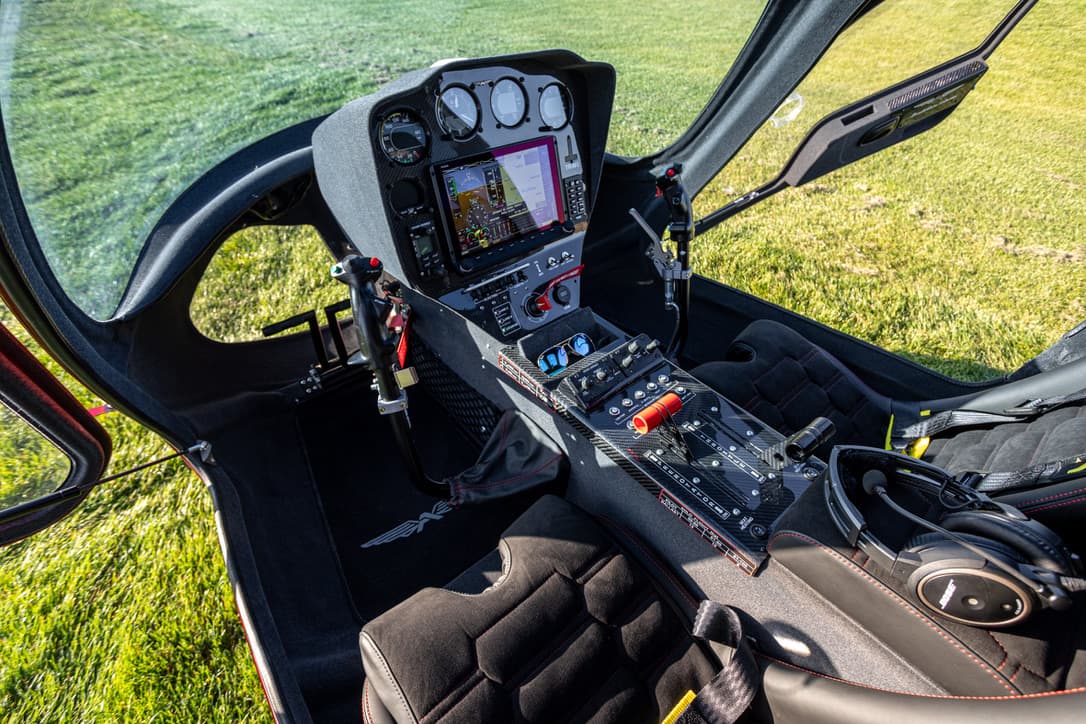
Gyroplane Ground School and the Flying Test
The five exams, and every item the examiner may test you on
Five written exams at 75%, and a General Flying Test in four sections that begins with an oral: at least two questions in each of seven categories, starting with weight and balance. Most schools will tell you that much. Below is the whole schedule, item by item, as the Civil Aviation Authority writes it in Appendix J of Standards Document 44 - itself an extract of the examiner's own form, SRG2124.
Read it as what it is: the list your examiner is working from. The syllabus you train against is a separate document, and we set that out exercise by exercise in the PPL(G) syllabus.
The five written exams
| Subject | Must be passed |
|---|---|
| Aviation Law, Flight Rules and Procedures | Before first solo |
| Human Performance and Limitations | Before solo cross-country |
| Navigation | Before solo cross-country |
| Meteorology | Before solo cross-country |
| Gyroplane Technical | Before the General Flying Test |
Each is passed at 75%, and the passes must fall within the 24 months before you apply for the licence. The flying test itself must be completed within six months of finishing training.
How the test is conducted
The General Flying Test is flown with a Flight Examiner for gyroplanes, in an aircraft with at least two seats and working dual controls, with the examiner in the seat an instructor would use. You fly it as pilot in command, as though no one else were on board. You tell the examiner the checks and duties you are carrying out, and you use the checklist for that aircraft.
During the pre-flight preparation you - not the examiner - determine the power settings and speeds, and calculate the take-off, approach and landing performance from the flight manual. The examiner takes no part in flying the aircraft except for safety, to set up a test item, or to avoid holding up other traffic. You must have been trained on the same type you are tested on, and recommended for the test by whoever ran your training, who hands over your records.
Section 1: the type-specific oral
At least two questions in each category, pass mark 75%. This is the part students underestimate, and the first category is the one nobody revises.
- Weight and balance
- Performance
- Speeds
- Systems and warning lights
- Fuel
- Aircraft documentation
- Pilot maintenance
Weight and balance means your aircraft, with your weights, from its weighing report - what it can carry, what it may not, and what ballast it needs solo. If it is not fresh in your mind, the gyroplane weight limit works through the sum on the ARGON GTL. Aircraft documentation means the papers that must be on board and current. Pilot maintenance means what you are permitted to do yourself, and what you are not.
Section 2: pre-flight and post-flight
- Gyroplane knowledge: aircraft documents, fuel, mass and balance, performance, flight planning, NOTAMs, weather briefing, passenger safety brief
- Pre-flight inspection and action, location of parts and their purpose
- Cockpit inspection, starting procedure, running up
- Communication and navigation equipment checks, selecting and presetting frequencies
- Pre-take-off procedure, R/T procedure, ATC liaison and compliance
The walkaround is examined, not assumed - the order, the reasons and the parts you are touching. Ours is written out in gyroplane pre-flight checks, in the flight manual's own sequence.
Section 3: general handling
- Taxi and rotor management
- Take-off into the prevailing wind
- Normal circuit
- Landing to a full stop, or touch and go
- Landing, power on, to a fixed point
- Landing, power off, to a specified point
- Aborted take-off during speed build-up, before the climb
- Go-around from an approach to land
- Straight and level at slow, cruise and fast speeds
- Gentle turns onto a specified heading
- Climbing and descending turns onto a specified heading
- Recovery from a slow-speed descent, without power
- Recovery from a slow-speed descent, with power
- Flight into and out of a restricted or confined area
- Practice forced landing
- Recovery from an unusual attitude: nose high, high power
- Recovery from an unusual attitude: roll left, nose down
Section 4: abnormal and emergency procedures
By oral discussion rather than in the air:
- Simulated partial power: flying and landing
- Simulated throttle cable break
- Simulated trim failure, full rear trim, if applicable to the type
- Simulated trim failure, full forward trim, if applicable to the type
- Simulated engine fire in flight
- Simulated electrical fire in flight
Note what is not on the list: entering autorotation. In a gyroplane there is nothing to enter - the rotor is already autorotating, which is the whole difference between this test and a helicopter one.
Passing, and failing
Fail an item and you have failed that section. Fail one section and you repeat that section only; fail two or more and you retake the whole test. In a retest, failing any section - including one you already passed - means the whole test again. Everything must be finished within six months, and if two attempts do not produce a pass in all sections, you go back for more training. There is no limit on attempts.
At the examiner's discretion any manoeuvre may be repeated once, with a single exception: the practice forced landing.
If you already hold a licence
A holder of a UK pilot licence in another category may be credited with up to 15 hours of dual flying towards the PPL(G) - which is where the familiar "40 hours, or 25 if you already fly" comes from. What cannot be credited is the gyroplane time itself: 15 hours dual and 10 hours solo in gyroplanes stand whatever you have flown before. Ground exams may be credited where an equivalent standard was examined, but the UK air law exam is required in every case, and your instructor must satisfy themselves that the knowledge is still there.
The rest of the requirements - the hours, the cross-countries, the timing windows - are in the UK gyroplane licence, and what the whole thing costs is in how much a gyroplane licence costs.
Frequently asked questions
What does the examiner ask in the PPL(G) flying test?
The test opens with a type-specific oral in which the examiner asks at least two questions in each of seven categories - weight and balance, performance, speeds, systems and warning lights, fuel, aircraft documentation and pilot maintenance - with a 75% pass mark. The flight itself then covers pre-flight and post-flight procedures, general handling, and abnormal and emergency procedures by oral discussion. The schedule is Appendix J of CAA Standards Document 44, taken from examiner form SRG2124.
How many written exams are there, and what is the pass mark?
Five, each at 75%: Aviation Law before first solo; Human Performance and Limitations, Navigation and Meteorology before solo cross-country; and Gyroplane Technical before the General Flying Test. Passes must fall within the 24 months preceding the licence application.
What happens if I fail part of the test?
Failing any item fails that section. Fail one section and you repeat only that section; fail more than one and you retake the whole test. In a retest, failing any section - including one already passed - means the whole test again. All sections must be completed within six months, and failing to pass everything in two attempts requires further training. There is no limit on the number of attempts.
Can I have a second go at a manoeuvre during the test?
At the examiner's discretion, any manoeuvre or procedure may be repeated once - with one exception, the practice forced landing, which may not.
I already hold a UK licence on another type. Does that count?
Yes. A holder of a UK pilot licence in a different category of aircraft may be credited with up to 15 hours of dual flying experience towards the PPL(G) requirements, which is where the difference between 40 hours and 25 comes from. The 15 hours dual and 10 hours solo that must be flown in gyroplanes are not creditable, and the UK air law exam is required in every case.