

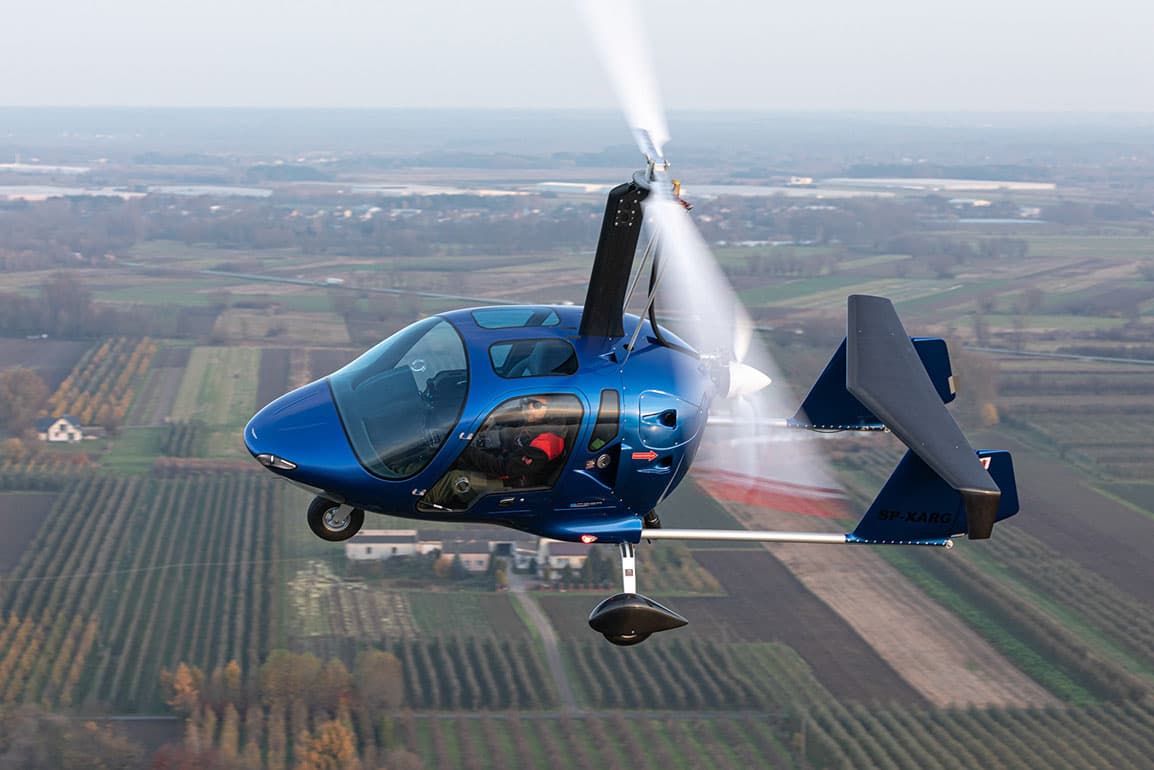
Gyroplane Pre-Flight Checks
The daily walkaround, the cabin check, and the three decisions made before you open the throttle
This is the ARGON GTL's own sequence, in the order its flight manual gives it - starting with a fuel sample, before the aircraft is moved. It is a companion to the aircraft's documents and replaces none of them: the manual must be on board and it is the authority. If you fly another type, the order will be similar and the wording will not - use yours.
Two things are worth saying before the list. The manual requires a daily inspection even if the aircraft flew yesterday. And it asks for it to be done, where possible, with a qualified person present, so that nothing is moved or started by accident.
The daily walkaround
| Fuel first, before the aircraft is moved | Take a small sample from each tank drain and from the gascolator into a fuel tester and look at it - water and dirt sink, so they come out first. A sample, not a drained tank. Do it before the aircraft is moved: moving it stirs any water back through the system and hides what you were looking for. |
|---|---|
| General | Magnetic switches off. Frost, snow, ice and mud removed. Documents on board. Loose items secured or removed. |
| Windows and glazing | Clean and undamaged. No alcohol-based cleaners. |
| Hull | Outer surfaces, stern support tubes, rotor mast and their attachments - no damage, corrosion or cracks. Drain and vent openings clear. Aerials sound. |
| Tail unit | Stabilisers and tailplane attachment, condition of the surfaces, Teleflex and its connection, rudder hinges and their locking, tail wheels. |
| Chassis | Legs, axles and hubs for damage and cracks; no cracks where the legs meet the fuselage; tyres at 2.0 bar and not worn; brakes undamaged, fluid level right, firm at the lever, disc bolts tight; nose gear turns freely. |
| Control system | Pedals, rudder and nose wheel through the full range, stop to stop. Stick smooth over its whole range, with the rotor head following it. Linkages tight, nothing bent, trim working. |
| Engine | Oil and coolant topped up. Cooling lines sound. Exhaust and turbocharger secure, no cracks or leaks, springs wired. Air filters clean and attached. Mounts and rubbers sound. Plugs and caps secure. Coolers attached and tight. Throttle cable full and free. Inspection doors closed on their quick-release fasteners. |
| Propeller | Blades and hub free of cracks and damage, blades secure to the hub and the hub to the shaft, and it turns smoothly by hand - ignition OFF, throttle closed. |
| Fuel system | Tanks, fastenings and caps; gauge compared against the visible level; shut-off valve working; filters clean and free of water. |
| Rotor | Rotor head condition and free movement. Teeter bolt, nut and split pin, and the bolt free to turn. Blade bolts and nuts. Blades clean and free of nicks, scratches and tears. Rotor swings freely to the stops. |
| Prerotator | Gearbox lubricated, belts undamaged, gears sound, drive free and lubricated, clutch bracket uncracked, prerotator brake holding with a few millimetres of play in the cable. |
| Cockpit | Doors, hinges and lock. Harnesses unfrayed and locking properly. Seats attached with pins engaged. Wiring undamaged. Electrics, radio and instruments working, battery charged. Placards legible. |
Anything that worries you goes to a competent person, and the flight does not happen until it is explained or fixed. That is the manual's wording, and it is the right standard.
In the cabin, before start
- Seats positioned - and the seat is only moved with nobody sitting in it.
- Doors closed and secured.
- Harnesses fastened.
- Control stick free through its range, then the friction or brake strap set.
- Luggage in its designated place and secured - 20 kg in the boot, 8 kg a side under the seats.
- Weight and ballast checked against the weighing report or the balance table. Flying solo, the ballast goes on the floor in front of the empty seat - and it comes out again before anyone sits there.
- Fuel confirmed physically in the tanks, not from the gauge: below about 20 litres the GTL's indication can be wrong.
The weight line is the one students skip and owners regret. Ask your instructor or your passenger what they weigh, add your own weight, the fuel and the bags, and check it against the aircraft's weighing report - the sum is worked through in the gyrocopter weight limit, where the GTL's limits are 110 kg on one seat, 200 kg on both, and 600 kg all up.
The three decisions before you open the throttle
Checks tell you the aircraft is fit to fly. These three tell you whether this flight should happen, and all three are made on the ground.
1. Decide where you will stop. Pick a point on the runway in advance - a marker, a gate, a tree - and decide that if you are not flying by it, you close the throttle and stop. Choosing that point while you are already rolling is not choosing it. The GTL's ground roll is short; what makes take-offs go wrong is deciding late, not deciding wrongly.
2. Decide what the wind is doing. Not just the strength - the direction, across the runway as well as along it, and where it will be by the time you are at 200 ft. A gyroplane gives you drift you have to fly out, and the allowance is worked out before you line up, not discovered afterwards. Look at the windsock again immediately before you roll: it is free, and it is current.
3. Decide whether your passenger is ready. Ask them, out loud, and listen to the answer rather than to the word. Somebody who is cold, nervous, needs the lavatory or did not sleep is a problem you cannot solve at 500 ft, and a briefed, warm, comfortable passenger is the difference between one flight and a lifetime of them. First-timers should be told what the take-off will feel like before it happens.
After the flight
The manual asks for a general visual inspection after flying too, and it is the cheapest maintenance there is: you are the only person who knows what the aircraft sounded like an hour ago. Anything you noticed in the air gets written down while you still remember it, not at the next annual.
If you are learning, all of this is part of the syllabus rather than an extra - the PPL(G) syllabus covers it across its 38 exercises, and the UK gyroplane licence explains where the hours and exams sit around them.
Frequently asked questions
What is a daily inspection on a gyroplane?
The walkaround carried out before the first flight of the day, in the order the flight manual gives: a fuel sample from each tank drain and the gascolator first, before the aircraft is moved, then hull, tail, chassis, controls, engine, propeller, fuel system, rotor, prerotator and cockpit. The ARGON GTL manual is explicit that it is needed even if the aircraft flew within the last 24 hours.
Do I need to check the weight before every flight?
Yes, and it is part of the manual's pre-flight check rather than an optional extra. Take the maximum take-off weight, subtract the empty weight from the weighing report, subtract fuel, and see what is left for people and baggage. Ask the instructor or passenger their weight before the flight, not after - it is a question about the aircraft, not about them.
Why does a solo flight need ballast?
Centre of gravity. The ARGON GTL manual says to place and secure suitable ballast on the floor in front of the empty seat when flying solo, and to remove it before a two-person flight. The aircraft also requires at least 60 kg on an occupied seat, for the same reason.
What are the three decisions before take-off?
Where you will abandon the take-off if it is not working; what the wind is doing and how you will allow for it; and whether the person beside you is genuinely ready. All three are made on the ground, because none of them can be made well in the air.