

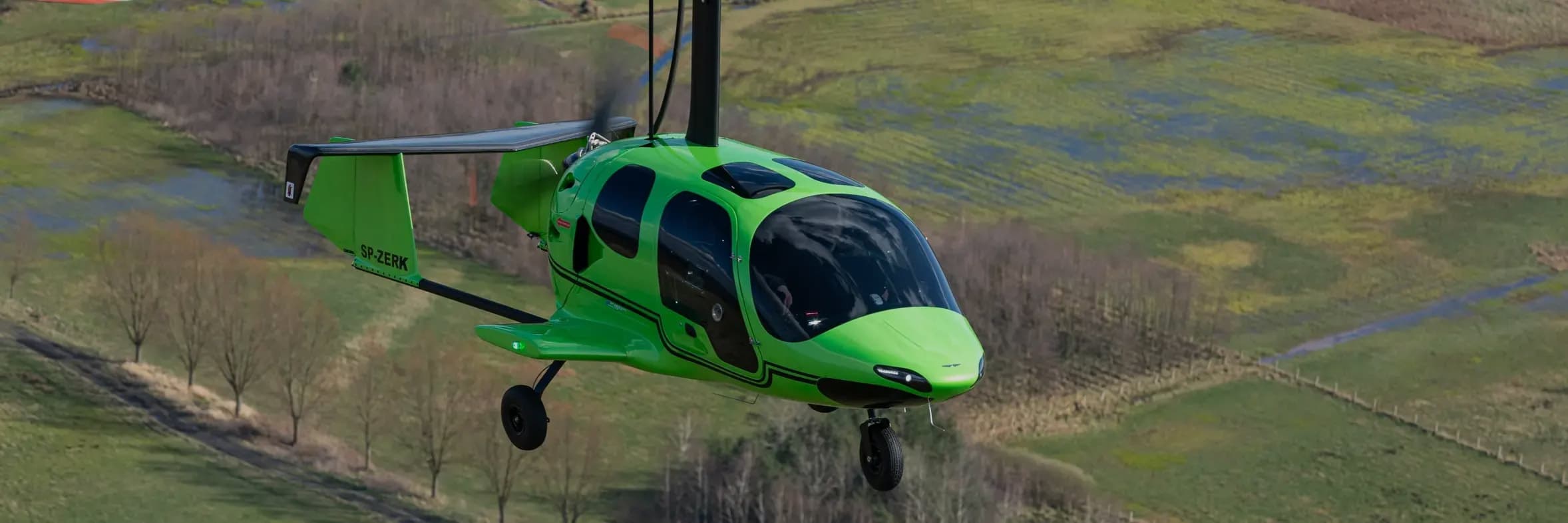
Are Gyrocopters Safe?
The engineering behind the confidence
It is the question every sensible person asks before leaving the ground, and it deserves a straight answer. Gyroplanes are among the most forgiving aircraft ever built - not by luck, but by physics. The very thing that makes a gyrocopter look unusual, its free-spinning rotor, is also the source of its safety.
The stall that cannot happen
A fixed-wing aircraft flies because air moves fast enough over its wing. Slow down too much and the wing stops working - it stalls, and can drop into a spin. A gyroplane has no such limit. Its rotor is always turning in autorotation, always producing lift, right down to very low airspeed. There is no stall in the fixed-wing sense, and therefore no stall-spin accident - the single biggest killer in light aviation simply is not on the menu.
What happens if a gyrocopter's engine fails?
Engine failure is not an emergency in the usual sense. In a helicopter, losing the engine means instantly entering autorotation - a demanding manoeuvre that has to be executed correctly, under pressure. In a gyroplane, autorotation is not the emergency - it is normal flight. The rotor is already unpowered and freewheeling every second you are airborne. If the engine stops, nothing sudden happens: the rotor keeps spinning, the aircraft keeps flying, and it descends gently to a landing that a trained pilot can put down in a remarkably short distance. How a helicopter fails against how a gyroplane fails is worth reading beside this, and so is gyrocopter vs helicopter.
The flight manual's emergency procedure is three lines long, and the first is simply a speed. What it does spell out is the instinct to resist: if the engine stops on take-off, do not turn back to the aerodrome, and do not alter heading by more than 30° either side. The turn back is what kills aeroplane pilots in the same situation. In a gyroplane it is unnecessary, because a field ahead is enough - 60 metres of it.
Can a gyrocopter glide?
Yes - the ARGON GTL's flight manual gives a best glide ratio of 4:1 at 90 km/h (49 kt). Four metres forward for every metre down: from 1,000 ft you reach something about 1,200 m away. That is worse than a light aeroplane, which will glide two or three times as far, and better than a helicopter. But the comparison misses the point, because distance is not what you are short of. An aeroplane glides further and needs a far longer, flatter, smoother place to arrive; a gyroplane arrives steeply, slowly and almost anywhere. The manual even says where to look for the spot: it is the one you can see through the lower window in front of your feet.
The manual also notes that flying with the engine off is safe across the whole speed range, with one instruction that matters: in a vertical descent, start accelerating back to normal speed by 80 to 100 metres above the ground so the landing can be flown properly. That is the skill the 40 hours of the PPL(G) exist to build.
Calm in rough air
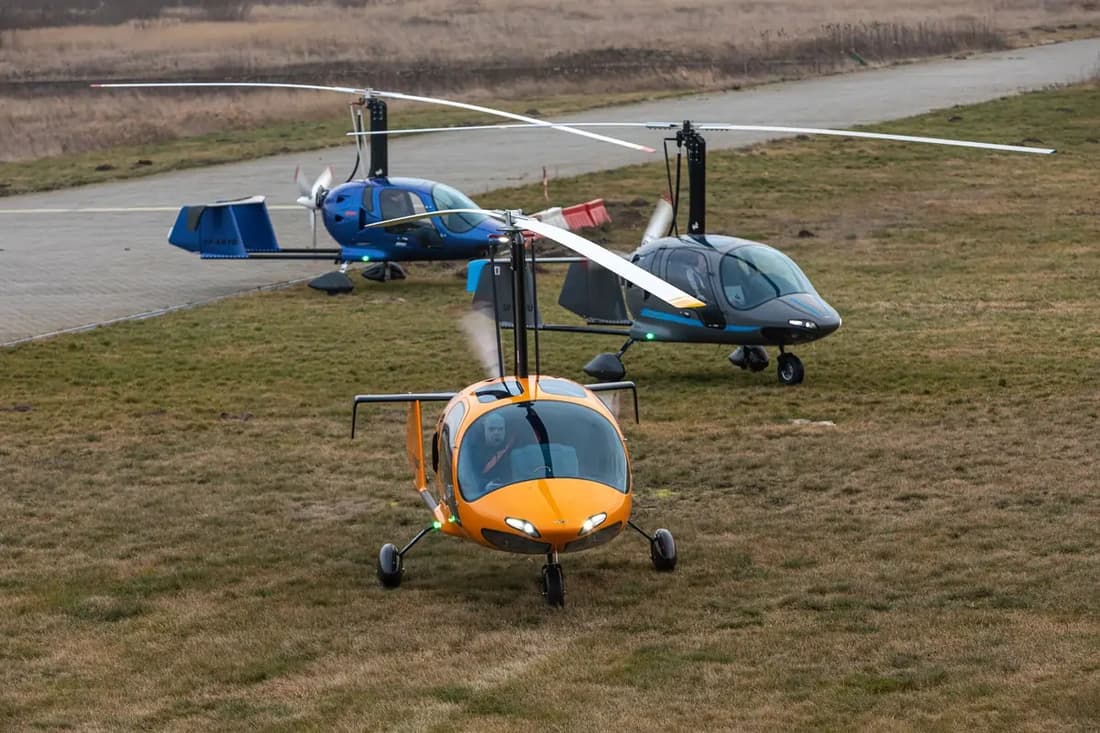
A spinning rotor behaves a little like a flywheel: it has inertia, and it smooths out the gusts and turbulence that would toss a light fixed-wing around. Gyroplanes are happy in conditions that ground many small aircraft. On the ground, the ARGON's wider wheelbase and doubled ground clearance add stability for takeoff and landing on grass or an improvised strip.
Are gyrocopters safer than helicopters?
In the one situation that frightens people most - the engine stopping - yes. A gyroplane is already in autorotation every second it flies, so an engine failure changes the noise and the rate of descent, not the way the aircraft flies. A helicopter pilot has to recognise the failure and enter autorotation within about two seconds, lowering the collective before rotor speed decays; it is a trained manoeuvre that works, but it has to be performed. A gyroplane also cannot stall or spin, has no tail rotor to lose, and needs no minimum height to land from.
Where the helicopter is ahead is the hover. It can stop, look, and put itself down vertically on a spot it has already inspected; a gyroplane needs forward speed and a short run of ground. The honest summary is that the gyroplane removes more ways to get into trouble, and the helicopter keeps one very good way of getting out of it. We sell both and say the same thing to every buyer: the choice is decided by whether you need to hover, not by which is the safer aircraft. The full gyrocopter vs helicopter comparison sets the two side by side on price, cost per hour and licence.
One caveat worth stating plainly, because it is where the gyroplane's older reputation comes from: early designs put the propeller thrust line well above the centre of gravity, which made them vulnerable to a power push-over if the pilot unloaded the rotor. Modern factory-built machines - the ARGON among them - align the thrust line through the centre of gravity and add a stabiliser, which is why that accident type belongs to a generation of aircraft rather than to the type.
Built to a standard, not a hope
Inherent physics is only half the story - the aircraft has to be built to match. The ARGON uses hand-made carbon and Kevlar rotors by ROTOR-TECH as standard, a wider stabiliser aligned with the propeller thrust line for stability, and a monocoque carbon fibre cabin. Production is held to CAA/EASA standards - and the CAA's BCAR-T regulations, the gold standard for gyroplane manufacture, have informed the design and build from the start. That engineering is exactly what our maintenance programme keeps airworthy over the aircraft's life.
The ARGON gyrocopter safety record
Physics and engineering are arguments. A record is evidence. Manufaktura Lotnicza publishes its own production and fleet figures, and they are worth reading together:
| ARGON aircraft flying | 150+ |
|---|---|
| Fleet flying hours | 27,350+ |
| Fatal accidents reported | None |
And the figure that matters most: the manufacturer reports no fatal accident across the ARGON fleet in those hours. We publish that as the manufacturer's statement rather than our own, and it is current as at August 2026 - if you are weighing this aircraft against another, ask both sellers the same question and see who answers it plainly.
Safety is also a skill
A forgiving aircraft still rewards a well-trained pilot. Proper training towards the UK Gyroplane Pilot Licence is where the gyroplane's built-in safety becomes real skill - including the helicopter-style spot landing that we discuss in French vs UK gyroplane licence. Fly a well-built gyroplane, trained properly, and you are flying one of the safest small aircraft in the sky.
Frequently asked questions
What is the ARGON safety record?
Manufaktura Lotnicza reports no fatal accident across the ARGON fleet. There are now more than 150 ARGON aircraft flying, between them well past 27,350 hours - the public counters on the factory's own site run behind the real number. We publish that as the manufacturer's statement rather than our own, current as at August 2026.
Are gyrocopters safe to fly?
Gyroplanes are widely regarded as one of the most forgiving categories of aircraft. The rotor is always in autorotation and always producing lift, so a gyroplane cannot stall or spin the way a fixed-wing aircraft can, and it stays controllable at very low airspeed.
What happens if the engine fails in a gyrocopter?
Very little drama. Autorotation - the emergency a helicopter pilot must perform on engine failure - is simply the normal state of flight for a gyroplane. If the engine stops, the rotor keeps spinning and the aircraft descends gradually under full control. The ARGON GTL's flight manual gives a best glide ratio of 4:1 at 90 km/h, and the landing needs about 60 metres of field. The one instruction the manual is emphatic about is not to turn back to the aerodrome if it happens on take-off: land ahead, within 30° either side.
Can a gyrocopter glide with the engine off?
Yes. The ARGON GTL's flight manual gives a best glide ratio of 4:1 at 90 km/h (49 kt) - four metres forward for every metre down, so roughly 1,200 m of range from 1,000 ft. That is shorter than a light aeroplane's glide and longer than a helicopter's, but the distance matters less than the arrival: a gyroplane comes down steeply and slowly and needs about 60 metres of field, where an aeroplane needs a long smooth one.
Can a gyrocopter stall or spin?
No. The free-spinning rotor keeps generating lift even at very low forward speed, so there is no stall in the fixed-wing sense and no associated spin. This is one of the core reasons gyroplanes are considered so safe.
Are gyrocopters safe in windy weather?
Gyroplanes handle gusts and turbulence well - the rotor disc acts a bit like a flywheel, smoothing out bumps. Wide-track designs such as the ARGON add ground stability for takeoff and landing on grass or rough strips.
How do I learn to fly a gyrocopter safely?
Through proper training towards the UK Gyroplane Pilot Licence (PPL(G)), with an approved organisation and certified instructors. Training is where you learn the fine control - including the helicopter-style spot landing - that turns the gyroplane's inherent safety into real skill.