

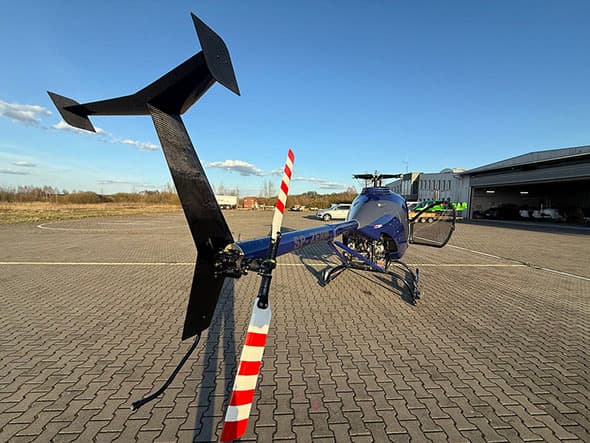
What Happens If a Helicopter's Tail Rotor Fails?
And why the propeller on the back of a gyroplane is not the same thing at all
Stand behind a helicopter and behind a gyroplane and you see the same silhouette: a big rotor on top, a smaller spinning thing at the back. It is a reasonable assumption that they are versions of each other and that losing either one is the same problem.
They are not versions of each other. They do unrelated jobs, and the difference is the most interesting thing about how these two aircraft fail. We sell both, so we have no reason to make either look bad.
What the tail rotor is for
A helicopter's engine drives its main rotor. Turn something that big that hard and it tries to turn you the other way - Newton's third law, applied to an aircraft with nothing to brace against. Without help, the fuselage would simply rotate beneath the rotor.
The tail rotor is the help. It sits on a long arm and pushes sideways, cancelling that torque, and the pilot varies its pitch with the pedals to point the nose. It is doing that job every second the engine is driving the rotor. It is not a trim device or a nicety. It is what makes a helicopter a flyable aircraft rather than a spinning one.
The three ways it goes wrong
"Tail rotor failure" is three different emergencies with three different answers, and lumping them together is where a lot of internet advice goes wrong.
Loss of drive
The shaft or the gearbox goes, and the tail rotor stops turning. Nothing is opposing the engine torque any more.
The most serious of the three. The fuselage yaws hard against the direction of the main rotor. The standard answer is to take the torque away - close the throttle and enter autorotation - then use forward speed so the fin weathercocks the aircraft straight, and put it on with a run-on landing.
Loss of control
The tail rotor keeps turning but the pilot can no longer change its pitch, so it is stuck at whatever it was set to.
Much better. Torque is still being opposed, just not adjustably. The aircraft is usually flyable to a run-on landing at a speed that matches the pitch the tail rotor is stuck in.
Loss of tail rotor effectiveness
Not a mechanical failure at all - an aerodynamic one. At low airspeed and in certain wind directions the tail rotor stops doing its job properly.
Recoverable, and the recovery is counter-intuitive: lower the nose, get airspeed, fly out of it. It catches people because the machine feels broken when it is not.
Notice what the first answer actually is: take the engine out of the equation. The way you deal with losing the thing that fights torque is to stop producing torque - and a helicopter without engine torque is a helicopter in autorotation, which is to say, a gyroplane. The recovery from the helicopter's worst mechanical failure is to spend thirty seconds flying the way a gyroplane flies all the time.
Our propeller is at the back too, and it is not a tail rotor
A gyroplane's rotor is turned by the air passing up through it as the aircraft moves, not by the engine. Nothing is driving it, so nothing is being twisted, so there is no torque reaction to cancel. The propeller at the back pushes the aircraft forward and does nothing else. Yaw is handled by an ordinary rudder in the airflow, the same as on an aeroplane.
So the two failures are not comparable, and it is worth setting them side by side:
- Helicopter, tail rotor gone. The aircraft has lost the thing holding it straight. It yaws, and the pilot must act correctly and quickly to fly it to a run-on landing.
- Gyroplane, propeller gone. The aircraft has lost thrust. The rotor turns on exactly as before, because it was never getting anything from the engine in the first place. It becomes a glider with a very steep, very controllable descent.
Engine failure: the difference is the first two seconds
This is the comparison people usually want, and it is fair to both aircraft.
A helicopter can absolutely be landed with the engine stopped. Autorotation works, it is trained, it is practised, and the freewheel unit that lets the rotor spin on when the engine stops is there for exactly that purpose. But the rotor is being driven at the moment of failure, and the moment it is not, its RPM starts to decay. The collective has to come down within a second or two. That is why serious light helicopters are built with high-inertia rotors - our ARGO AH uses a three-blade high-inertia composite rotor precisely to widen that window - and why the manoeuvre is drilled until it is reflex.
A gyroplane has no such window, because there is nothing to catch. The rotor was in autorotation before the engine stopped and it is in autorotation afterwards. Nothing about the rotor's behaviour changes. The pilot lowers the nose, picks a field and lands - and engine-off landings are taught early in the course, not as an emergency drill bolted on at the end but as the ordinary way the aircraft comes down.
That is the whole of the safety argument, and it is narrower than the internet usually makes it: not that the gyroplane is a better aircraft, but that it asks less of the pilot on the worst day.
What we are not claiming
A gyroplane has hazards of its own and pretending otherwise would be the kind of sales talk that gets found out. It cannot hover, so it cannot hold station over a casualty or land vertically into a clearing. Its rotor has to be handled properly on the ground in wind, which is a skill rather than a danger but has to be learned. And gyroplanes are sensitive to abrupt handling in a way that training exists to address.
On the record: there are now more than 150 ARGON aircraft flying, between them well past 27,350 hours, and the manufacturer reports no fatal accident across that fleet. The public counters on the factory's own site run behind the real number. We publish this as the manufacturer's statement rather than our own, current as at August 2026 - and if you are comparing aircraft, ask every seller the same question and see which of them answers it with a number at all.
Which one should you be flying?
If you need the hover - a confined landing site, a load on a hook, holding still above one point - nothing here replaces a helicopter, and that is why we sell one. If you want hours in the air, £55,000 less to buy, and an aircraft whose emergency procedure is roughly the same as its normal one, the gyroplane is the answer.
The full comparison, with costs, is in gyrocopter vs helicopter, and the endurance side of it in how long a helicopter can stay in the air.
Frequently asked questions
What happens if a helicopter's tail rotor fails?
It depends which failure it is. If the drive fails the tail rotor stops turning and nothing opposes the engine torque, so the fuselage yaws hard the opposite way to the main rotor - the standard response is to remove the torque by entering autorotation and land with forward speed so the fin keeps the aircraft straight. If only the control fails, the tail rotor keeps opposing torque at a fixed pitch and the aircraft is usually flyable to a run-on landing. Loss of tail rotor effectiveness is aerodynamic rather than mechanical and is flown out of by gaining airspeed.
What is loss of tail rotor effectiveness?
An aerodynamic condition rather than a breakage. At low airspeed, in a hover or close to it, certain wind directions can disturb the airflow through the tail rotor enough that it no longer holds the aircraft straight, and the helicopter begins to yaw. The recovery is to lower the nose and gain airspeed. Nothing is damaged, which is exactly why it surprises pilots.
Why does a gyroplane not have a tail rotor?
Because there is no engine torque to oppose. A helicopter needs a tail rotor because its engine drives the main rotor, and every action has a reaction that tries to spin the fuselage the other way. A gyroplane's rotor is turned by the air passing through it, not by the engine, so nothing is being twisted and nothing needs cancelling. The propeller at the back of a gyroplane looks like a tail rotor and does an entirely different job - it pushes the aircraft forward and that is all.
Can a helicopter land without an engine?
Yes. It is called autorotation, every helicopter pilot is trained in it and it is practised regularly. The engine is disconnected by a freewheel unit and the airflow up through the descending rotor keeps it turning; near the ground the pilot trades that stored rotor energy for a cushioned landing. What it asks for is an immediate and correct reaction - the collective has to come down within a second or two to keep the rotor RPM up, which is why helicopter rotors are built with high inertia to widen that window.
What happens if the engine fails in a gyroplane?
Very much less. A gyroplane is already in autorotation - it is the normal state of flight, not an emergency configuration - so an engine failure costs thrust rather than lift. The rotor carries on turning exactly as it was a moment earlier and the aircraft descends in a controlled glide at a fairly steep angle. There is no window to react in, because nothing has to be changed.
Are gyrocopters safer than helicopters?
They fail more gently, which is not the same thing as being a better aircraft. A gyroplane cannot stall, has no tail rotor to lose and needs no reflex on engine failure. A helicopter can hover, can land vertically in a space the size of a tennis court and can lift a load - none of which a gyroplane can do at all. Both are safe in trained hands. We sell both, which is why we can say that without flinching.