

How Long Can a Helicopter Stay in the Air?
About two hours - and why the British police bought aeroplanes because of it
Roughly two and a half hours for a light helicopter on internal fuel, and about two for the machines that circle over British cities at night. Nothing exotic limits it - not the engine, not the airframe, not the pilot. It is fuel, and a helicopter drinks it faster than almost anything else that flies.
We sell helicopters and we sell gyroplanes, so the interesting part of this question for us is not which one wins. It is that the answer explains why serious operators buy both.
Why a helicopter cannot stay up longer
A helicopter's engine turns its rotor, and the rotor is the only thing holding the aircraft up. Power goes into staying airborne every second of the flight, whether the machine is travelling somewhere or hovering over one spot. There is no gliding phase and nothing free about it.
The numbers from our own ARGO AH flight manual: 75 litres in the tank, 20 to 25 litres an hour in the hover, 20 to 28 at a 120 km/h cruise, and 24 to 36 planned depending on weight and conditions. The manufacturer's specification gives a maximum range of 320 km including a 10% reserve. That is a two-and-a-half-hour aircraft, and it is a well-designed one - the limit is the physics of powered lift, not the machine.
How long can a police helicopter stay in the air in the UK?
This is the version of the question most people are actually asking, and the answer is about two hours.
What makes it worth knowing is what the police did about it. The National Police Air Service now flies four Vulcanair P68R aeroplanes alongside its 19 helicopters. The aeroplanes stay airborne for as much as eight hours at roughly a third of the running cost, and they take the long surveillance tasks so that the helicopters stay free for urgent calls - which also spreads airframe hours and crew fatigue across the fleet.
In other words, the organisation in Britain with the most experience of keeping an aircraft over one place for a long time did not pick a winner. It bought both kinds and gave each one the job it is good at.
Two and a half hours against five
A gyroplane sits between the two. Its rotor is turned by the air passing through it rather than by the engine, so the engine only has to push the aircraft forward - nothing is being spent on lift. An ARGON GTL carries 116 usable litres and burns 23 an hour, which is 5 hours and 2 minutes, or 757 km.
That difference is why some forces fly gyroplanes rather than helicopters for work measured in hours over the ground - police patrol, a long border and search and rescue, where China's border unit reports patrol times 70 per cent shorter than on foot, and a Texas department flies one for about $50 an hour.
| ARGO AH helicopter | ARGON GTL gyroplane | |
|---|---|---|
| Fuel on board | 75 litres | 116 litres usable |
| Burn at cruise | 20 to 28 l/h | 23 l/h |
| Time in the air | About 2½ hours | 5 hours 2 minutes |
| Distance | 320 km, with 10% reserve | 757 km |
| Best-range speed | 120 to 130 km/h | 150 km/h |
| Cost per flying hour, all in | £97.23 at 150 hours a year | £89.11 at 150 hours a year |
| Can it hover? | Yes | No |
| Take-off run | None - vertical | A few dozen metres of grass |
Twice the time and well over twice the distance. Not at a third of the hourly cost, though - that is a claim you will see made and it is not true. On the manufacturer's own like-for-like method the two are within about 9% of each other per hour at 150 hours a year. The gyroplane's advantage is the £55,000 lower purchase price and the hours in the air, not the hourly rate. Those figures come from the manufacturer's own flight manuals, which we mirror on this site so you can check them rather than take our word.
The pair is better than either one
Read the table again and the complementarity is obvious. The gyroplane has the endurance and the cheap hour. The helicopter has the hover and the vertical landing. Neither can be given the other's strength by trying harder.
So if the task is to find something - a walker missing on a hillside, a coastline after a storm, livestock across a large estate, a pipeline, a fence line - the aircraft you want is the one that can stay up for five hours and still be affordable on the fourth. And if the task is to reach what has been found and put a person on the ground or lift one off it, only the helicopter will do.
The gyroplane searches and holds. The helicopter arrives and does the work. That is precisely the logic NPAS applied when it bought aeroplanes to fly beside its helicopters, and it scales down to two aircraft as neatly as it scales up to twenty-three.
What that means in the UK, said plainly
One caution we would rather give here than after a deposit. Aircraft on a UK Permit to Fly are private aircraft: commercial air transport, aerial work and carrying passengers for reward are not available without the CAA's specific consent. So the pairing above describes a capability honestly, and describes a private or estate operation rather than a contract. If your intended use is commercial, that position needs confirming with the CAA before anyone spends money, and we will help you ask the question properly rather than guess at the answer.
The helicopter, in the flesh
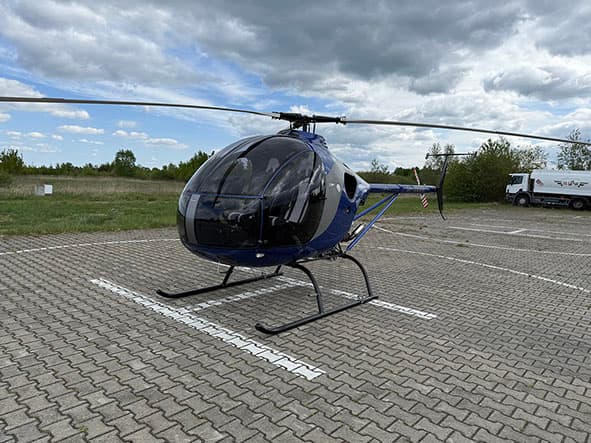
The ARGO AH: two seats side by side, titanium and composite airframe, three-blade high-inertia rotor, Garmin glass and a three-axis autopilot.
If you are choosing one
Buy the helicopter if you need to land where there is no run at all, or to hover. Buy the gyroplane if you need hours in the air, distance, and a running cost you can absorb without thinking about it. The full cost comparison is set out in gyrocopter vs helicopter, and the helicopter's own figures in what an ARGO AH costs.
And if the honest answer is that you want both - we are the UK dealer for both, which is not a sentence many people can write.
Frequently asked questions
How long can a helicopter stay in the air?
A light two-seat helicopter, about two and a half hours. Our ARGO AH carries 75 litres and burns 20 to 28 litres an hour at cruise, and the manufacturer's specification gives a maximum range of 320 km including a 10% fuel reserve. Larger machines carry more fuel but burn proportionally more: the UK's police helicopters are quoted at a maximum of about two hours.
How long can a helicopter stay in the air without refuelling?
Exactly as long as the fuel lasts, which is the whole answer - nothing else in the machine limits it first. A helicopter has to power its rotor continuously just to stay up, so it burns fuel at roughly the same rate whether it is going somewhere or hovering over one spot. That is why endurance figures for helicopters cluster around two to three hours rather than the six or eight an aeroplane manages.
How long can a police helicopter stay in the air in the UK?
About two hours at most. The National Police Air Service found that limiting enough to buy aeroplanes: its four Vulcanair P68R fixed-wing aircraft stay up for as much as eight hours at around a third of the running cost, flying the long surveillance tasks so the 19 helicopters stay free for urgent calls. The police solved the endurance problem by operating both types rather than by choosing one.
How many hours can a helicopter stay in the air?
Two to three for most light and medium helicopters on internal fuel. Auxiliary tanks extend it and air-to-air refuelling extends it further on military types, but for anything you would buy privately, plan on two and a half hours and land with a reserve.
Why can a gyrocopter fly longer than a helicopter?
Because it does not spend fuel making lift. A helicopter's engine drives the rotor, so power is going into staying airborne every second of the flight. A gyroplane's rotor is turned by the air passing through it and the engine only pushes the aircraft forward, so an ARGON GTL flies for 5 hours and 2 minutes on 116 litres where the helicopter manages about two and a half on 75.
Are gyrocopters safer than helicopters?
They fail more gently. A helicopter that loses its engine must be put into autorotation quickly and correctly, and a helicopter that loses its tail rotor has a serious emergency. A gyroplane's rotor is already in autorotation for the whole flight, so an engine failure costs thrust rather than lift and the aircraft descends under control. Neither aircraft is dangerous in trained hands, but the gyroplane asks less of the pilot on the worst day.
And what those hours cost: buying and running a two-seat helicopter.