

Gyrocopters for Police, Border Patrol and Search and Rescue
Five hours in the air, at about the cost of a car
A gyroplane suits patrol work for one reason: it buys hours in the air cheaply. An aircraft of this class stays up for about five hours on ordinary unleaded, flies slowly enough to look at the ground properly, and costs a fraction of a helicopter to buy and to maintain. Over a long border or a large search area, that is the whole argument - what finds things is time over the ground, and time over the ground is what an air unit usually cannot afford.
What it gives up is the hover. A gyroplane cannot hold a position over a scene, cannot winch and cannot lift a casualty. It is a set of eyes that can stay out all morning, not a rescue platform.
Who already does this
Not many forces, and none in Britain. But the examples that exist are not trials - they are units that have been flying for years.
China: the Gobi border patrol, flying since 2020
China's first border police gyrocopter unit was set up in July 2020 in the Mazong Mountain border zone at Jiuquan, in Gansu province, where China meets Mongolia. Seven officers, average age under thirty, cover about 26,000 square kilometres of mostly Gobi desert.
The figure that matters is the one they give for the work itself: patrol times 70 per cent shorter than ground operations. The aircraft they describe carry up to three people, fly at over 180 km/h, range 700 km and stay airborne five hours. Their stated reason for choosing gyrocopters over helicopters was that helicopters are complex to operate and difficult to maintain.
That is reported by China Daily, 10 October 2024, and the figures above are theirs, not ours.
Texas: $75,000 to buy, about $50 an hour to fly
Tomball Police Department, north of Houston, bought an AutoGyro MTOsport in 2011. The price was $75,000 and the running cost about $50 an hour, because it flies on pump petrol rather than avgas. The chief's own description of what it was worth to him was that the gyroplane is equal to the deployment of twenty officers.
Reported by Police1, 15 September 2011. Fourteen years old, and still the clearest published set of numbers for a police gyroplane anywhere.
Salt Lake City: perimeter patrol at the 2002 Olympics
A Groen Brothers Hawk 4 gyroplane flew perimeter patrol for the 2002 Winter Olympics and Paralympics, reported as 67 missions during a ninety-day contract. It is the oldest of these three examples and the least well documented, and it is included because it shows the job is not new.
Why the endurance is the point
A border is long and a search area is large, and both are searched by covering ground slowly enough to see. That makes the useful measure not top speed but hours per tank, and hours per pound.
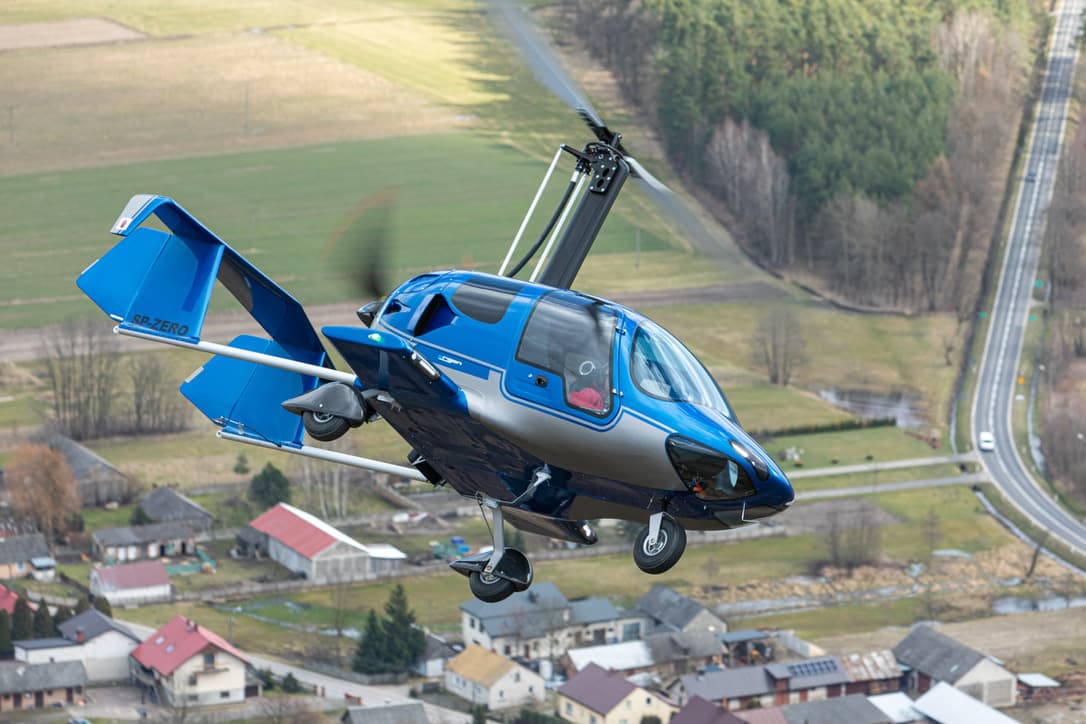
The ARGON GTL carries 130 litres and is published at up to five hours, up to 620 miles with external tanks. It will fly as slowly as 40 knots without falling out of the sky, which is what lets a crew actually look at what they are passing over, and it takes off in 100 metres and lands in 60 - so it operates from a strip near the border rather than from an airfield two hours away.
| Endurance | Up to 5 hours |
|---|---|
| Range | Up to 620 miles with external tanks |
| Fuel | 130 litres, plus optional external tanks |
| Minimum speed (VSO) | 40 kt (47 mph) |
| Never exceed speed (VNE) | 113 kt (130 mph) |
| Seats | Two, side by side |
| Take-off roll | 100 m at 600 kg, sea level, hard surface |
| Landing roll | 60 m |
The three things it cannot do
Any honest case for this aircraft has to put these first, because a force that discovers them after buying has bought the wrong thing.
It cannot hover. The rotor is turned by air flowing through it rather than by the engine, so the aircraft must keep moving. It can orbit slowly and keep something in sight; it cannot hold still above a scene. That single capability is most of the difference between the two aircraft.
It cannot lift or winch. Two seats, side by side, and a luggage compartment. It finds and directs; something else recovers.
It cannot fly at night or in cloud, under UK rules. A gyroplane on a UK permit to fly is day VFR only. That is a limitation of the permit rather than of the machine, and other countries write their own rules - but in Britain it means a daylight, good-visibility aircraft, and any proposal that ignores it is not a serious proposal.
Questions people ask
- Do police use gyrocopters?
- Yes, though not many forces and not in Britain. China's first border police gyrocopter unit has flown the Mazong Mountain border zone in Gansu province since July 2020 - seven officers covering 26,000 square kilometres of Gobi desert - and China Daily reported in October 2024 that its patrol times are 70 per cent shorter than the ground patrols it replaced. In the United States, Tomball Police Department in Texas bought an AutoGyro MTOsport in 2011 for $75,000 and runs it for about $50 an hour on ordinary pump petrol. A Groen Hawk 4 gyroplane flew perimeter patrols at the 2002 Winter Olympics in Salt Lake City.
- Why use a gyroplane instead of a helicopter for patrol work?
- Hours in the air for the money. A gyroplane of this class stays up for about five hours on a tank of ordinary unleaded, costs a fraction of a helicopter to buy and is far simpler to maintain - it has no tail rotor, no gearbox driving the main rotor in flight and no collective. The Chinese unit's stated reason was exactly this: that gyrocopters are more agile and efficient than helicopters, which are complex to operate and difficult to maintain. What you give up is the hover.
- Can a gyroplane hover over a scene?
- No. A gyroplane's rotor is turned by airflow rather than by the engine, so it needs forward movement to fly and cannot hold a position over a spot. It can circle slowly - the ARGON GTL's minimum speed is 40 knots, about 47 mph - which is enough to keep something in view, but it is not a hover. If the job requires holding still above a scene, lowering a winch or lifting a casualty, it requires a helicopter.
- Can a gyroplane be used for search and rescue?
- For searching, yes; for the rescue itself, no. What finds people is time over the ground at low speed, and a gyroplane gives about five hours of it at a cost per hour that makes a long search affordable rather than exceptional. It cannot hover, winch or carry a casualty, so it finds and directs rather than recovers. In practice that is a spotting aircraft working with whatever does the lifting.
- Can a gyroplane fly at night or in bad weather?
- Not under UK rules. A gyroplane on a UK permit to fly is restricted to day VFR - daylight, out of cloud, in sight of the surface - so a force flying one has an aircraft for daylight and good visibility only. Other countries write their own rules, and the equipment fitted is a separate question from what the permit allows.
- What does a police gyroplane cost to run?
- Tomball Police Department gave about $50 an hour in 2011, on pump petrol rather than avgas, for an AutoGyro MTOsport bought at $75,000. Our own published figure for the ARGO AH-22 helicopter, for comparison within our own range, is about £97 a flying hour on road petrol. Any figure like this excludes the pilot, the hangar and the annual inspection, so treat it as the fuel and direct running cost rather than the cost of operating an air unit.
If this is the job you have
We are the UK dealer for Manufaktura Lotnicza and we sell the aircraft, not the operation - a force or an agency buying one needs its own regulator's answer on registration and on what the aircraft may be used for, and that answer differs in every country. What we can give you is the flight manual, the real figures and an aircraft to fly in before anybody signs anything.