

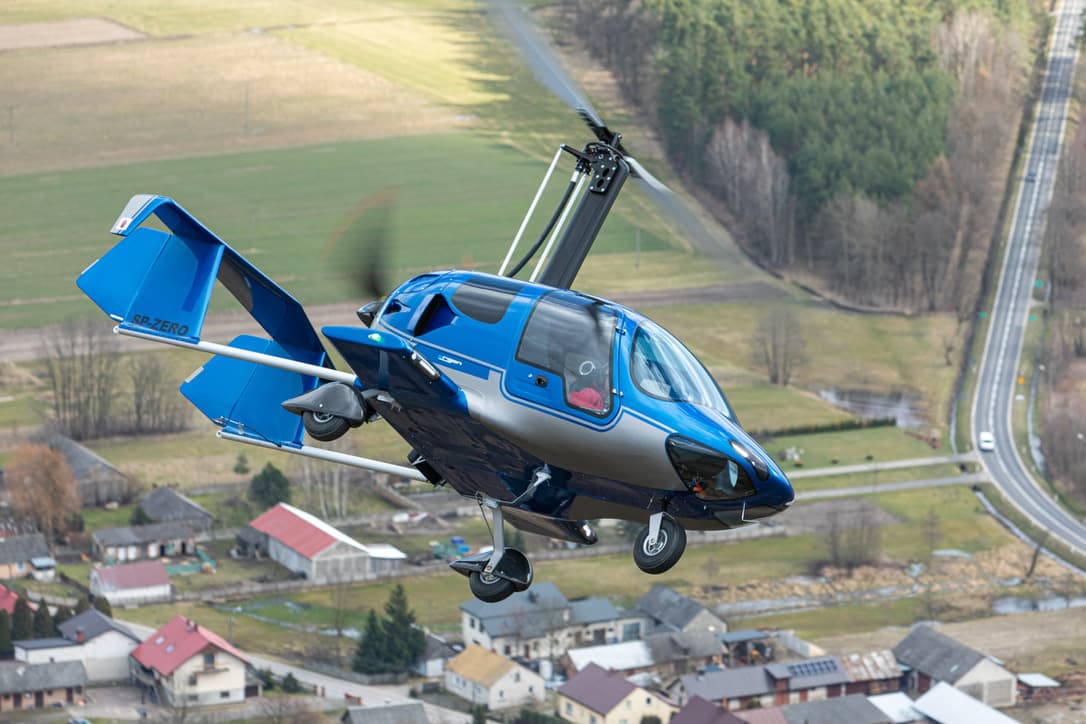
How Much Runway Does a Gyrocopter Need?
100 metres to go, 60 to stop - and what doubles both
About 100 metres to take off and 60 metres to land. Those are the ARGON GTL's own figures, at the full 600 kg take-off weight, on a hard surface, at sea level in standard conditions. If there is a hedge and a line of trees at the end of the strip - the 15 metre obstacle the manual measures to - it is 280 metres to take off and 180 to land.
So the honest answer to the question people actually ask is: no, you do not need a runway, but you do need a run. The rest of this page is where those numbers come from, what makes them worse, and the one thing a gyroplane still cannot do.
The figures, from the flight manual
| Take-off ground roll | 100 m (328 ft) |
|---|---|
| Take-off distance over a 15 m / 50 ft obstacle | 280 m (921 ft) |
| Lift-off speed | 85 km/h IAS (46 kt) |
| Landing ground roll | 60 m (197 ft) |
| Landing distance over a 15 m / 50 ft obstacle | 180 m |
| Approach speed | 90 km/h IAS (47 kt) |
| Minimum speed, VMIN | 50 km/h IAS (27 kt) |
| Rate of climb at sea level | 7 m/s (1,400 ft/min) |
All of it is chapter 5 of the ARGON GTL flight manual, which is published in full on this site rather than summarised. The conditions matter as much as the numbers: 600 kg, sea level, standard atmosphere, no wind. Read any manufacturer's take-off figure without its conditions and you are reading an advertisement.
Do gyrocopters need a runway?
No - they need firm level ground, and about a hundred metres of it. The reason is the rotor. A gyroplane's rotor is not driven by the engine in flight; it turns because air flows up through it as the aircraft moves, which is autorotation. No forward movement, no airflow, no lift.
What shortens the run is that the rotor does not start from nothing. Standing still, a pre-rotator drives the rotor up to between 210 and 230 rpm before the brakes come off. The take-off roll is then spent accelerating the aircraft rather than the rotor, and at about 85 km/h it flies. A fixed-wing aeroplane on the same 160 hp engine has to reach its own flying speed from a standing start with nothing spinning, and needs several times the distance to do it.
Gyrocopter landing distance
Sixty metres of ground roll, from an approach at 90 km/h. That is the certified figure at maximum weight in still air, and in practice a well-flown gyroplane beats it comfortably: the approach can be far steeper than an aeroplane's, and the minimum speed in the manual is 50 km/h - about 31 mph, slower than a car on a British B road. Into a headwind the groundspeed at touchdown can be almost nothing.
Thirty-five seconds, filmed at our partner school: the approach, the touchdown, and how far it actually rolls.
Can a gyrocopter take off vertically?
No, and anyone who tells you otherwise is selling something. A gyroplane cannot hover and cannot climb straight up, because the rotor is unpowered once you are moving. The pre-rotator spins it on the ground and then disengages; it has no way of driving the rotor hard enough to lift the aircraft off its wheels.
That single capability is most of what separates the two aircraft we sell. An ARGO AH-22 helicopter drives its rotor, so it needs no run at all and can put itself down on a spot it has already looked at. It also costs £220,000 against £165,000, and the licence behind it costs roughly five times as much. If you need to hover, nothing else will do; if you do not, the full comparison sets the two side by side on price and cost per hour.
What doubles the distance
The flight manual puts its own warning in bold, and it is the sentence to remember out of this whole page: wet runways, grass and unmown grass can easily double the take-off distance. A hundred metres becomes two hundred on the sort of field most people imagine when they picture landing a gyroplane in the countryside.
Heat and height do it again. The manual's own worked example takes an aerodrome at 6,600 ft pressure altitude at 5°C and extends the take-off distance by 100% while cutting the rate of climb in half. Neither correction is exotic - a warm day at a Spanish or Georgian strip in summer will do it. The practical rule is to plan on double the book figure and be pleased when you do not need it, and the manual says as much itself: the values from the correction diagram must not be used without further safety margins.
Can you land a gyrocopter anywhere?
Physically, on any firm level 60 metres. Legally is a different question, and the aircraft is rarely the limiting factor. In the UK you need the landowner's permission to use a site, and the ordinary rules of the air still apply - including keeping 500 ft from any person, vessel, vehicle or structure not under your control, which is the rule that governs almost every low flight in Britain. Abroad it changes again, country by country: where you can fly a gyrocopter in Europe sets out what the registration and the licence have to be.
What the short field really buys you is not landing in a stranger's meadow. It is that a farm strip near your house becomes a viable base, that a club runway too short for a touring aeroplane is plenty, and that on a bad day you have a great many more options than an aeroplane does. That last one is worth more than it sounds: an engine failure in a gyroplane needs sixty metres of field, not a runway, and it is already flying in autorotation when it happens.
Before you build a strip
Four questions, in this order. What does the flight manual of the aircraft you will actually fly give for take-off roll and distance over 15 metres? What is the surface, and is it ever wet? What is at the end of the strip, and how high? And what is the elevation and the worst summer temperature? Answer those and the length you need falls out of the arithmetic rather than out of a brochure. Tell us the field and we will do that sum with you - the range and the prices are published, and so is what one costs to run.
Frequently asked questions
How much runway does a gyrocopter need?
About 100 metres to take off and 60 metres to land. Those are the ARGON GTL's figures from its flight manual, at the full 600 kg take-off weight, on a hard surface, at sea level in standard conditions. If you have to clear a 15 metre obstacle - a hedge and a line of trees at the end of the strip - the manual gives 280 metres for take-off and 180 metres for landing. Every type has its own numbers, and they are in its flight manual.
Do gyrocopters need a runway?
Not a runway, but they do need a run. A gyroplane's rotor is turned by air flowing through it rather than by the engine, so it needs forward speed before it will fly: the rotor is spun up on the spot first, then the aircraft accelerates to about 85 km/h and lifts off. A hundred metres of firm level ground is enough, which is why a farm strip, a grass field or a short club runway will do where an aeroplane of the same power would not fit.
Can a gyrocopter take off vertically?
No. A gyroplane cannot hover and cannot leave the ground vertically. Its rotor is unpowered in flight, so it produces lift only while air is flowing up through it, and that airflow comes from moving forward. A helicopter drives its rotor and can therefore hover and climb straight up; that capability is most of the difference in price between the two aircraft.
How short can a gyrocopter landing be?
Shorter than the manual figure, in skilled hands and into wind. The 60 metres in the flight manual is the certified distance at maximum weight in still air. Flown well, a gyroplane touches down almost on one spot and rolls a few metres, because its approach can be very steep and its minimum speed is only 50 km/h. What it cannot do is stop in the air first: the landing is short, not vertical.
Does grass make a difference to the take-off distance?
A large one, and the manual says so in a warning of its own: wet runways, grass and unmown grass can easily double the take-off distance. Heat and altitude add to it - the manual's worked example, an airfield at 6,600 ft pressure altitude at 5°C, extends the take-off distance by 100% and cuts the rate of climb in half. Plan a strip on the doubled figure, not the book figure.
Can you land a gyrocopter anywhere?
Physically, on any firm level ground of about 60 metres. Legally, no - in the UK you need the landowner's permission for the site, and the ordinary rules of the air still apply, including staying 500 ft from any person, vessel, vehicle or structure that is not under your control. The short answer is that the aircraft is rarely the limiting factor; permission is.