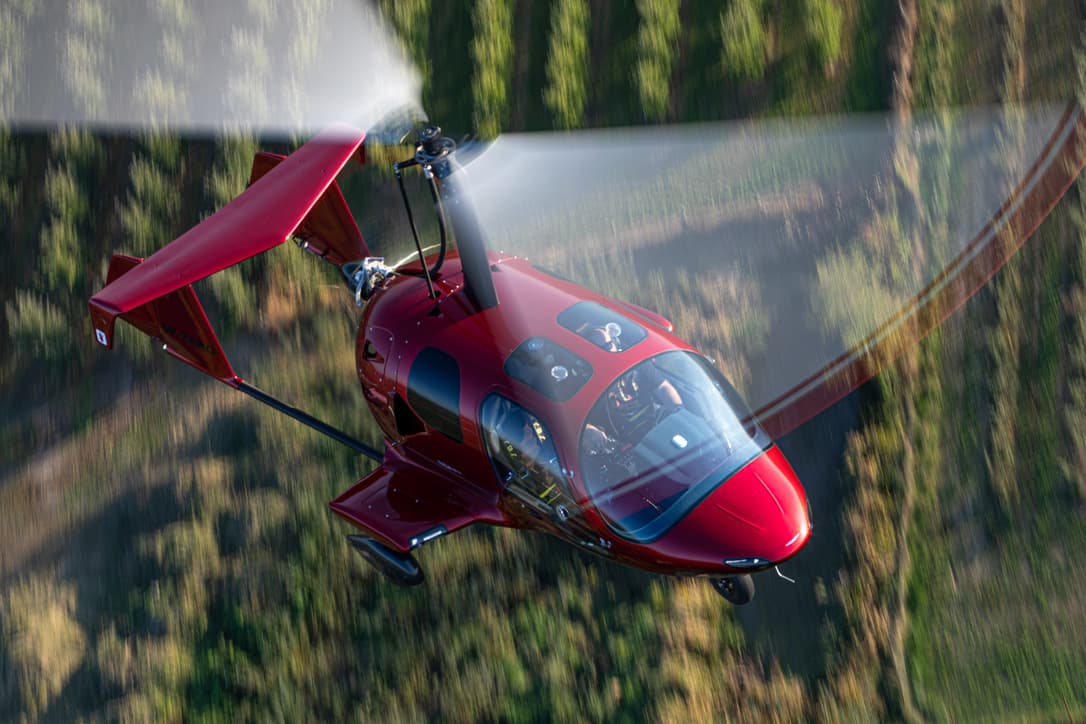
Gyroplane or eVTOL: the Next Five Years
What will we actually be flying, and is a gyroplane about to be overtaken?
A two-seat eVTOL is held up by its motors; a gyroplane is held up by air moving through a rotor that is never driven by the engine. Everything else in this comparison follows from that one sentence, and it is the reason the comparison will still be worth reading in ten years, long after every figure below has been revised.
The question behind that is the one worth answering, and it is not really a technical one. If you are about to spend six figures on an aircraft and you have just watched a video of an eight-rotor machine promising two hours in the air, what you actually want to know is whether you are buying a horse in 1910. For the next five years, the answer is no - and the reason has nothing to do with which design is cleverer.
The occasion is the DTA JP1, which is being shown at the air shows and pushed hard on YouTube: two seats, eight motors, a ballistic parachute, and a promise of two hours in the air. DTA are a French manufacturer, and it is worth knowing that they are better known for building gyroplanes. They are not outsiders to this argument. Neither are we: Argo Aero UK Ltd is the United Kingdom dealer for Manufaktura Lotnicza, who build the ARGON, and you should read what follows as an interested party describing its own aircraft.
Side by side
Our figures come from the manufacturer's flight manual. DTA's come from DTA. Where the press has filled a gap with a guess, the table says the figure is not published rather than repeating the guess.
| ARGON GTL | DTA JP1 | |
|---|---|---|
| What holds it up | A rotor turned by the air flowing through it | Eight motors |
| If the power stops | The rotor keeps turning. Engine failure has a procedure and it ends in a landing | A ballistic parachute. DTA say it flies on after losing up to three motors |
| Endurance | Up to 5 hours | Up to 2 hours - DTA's target |
| Speed | 240 km/h achieved on the 915. Never-exceed 207 km/h IAS in the flight manual | Up to 150 km/h - DTA's target |
| In rough air | Permitted to 175 km/h IAS in gusty air | Not published |
| Seats | Two, side by side | Two |
| Max take-off weight | 600 kg | Not published by DTA |
| Certification | Type documents in Poland, Germany, France, India, Turkey and Georgia | In progress |
| Has it flown with a person aboard? | Yes - hundreds of aircraft, for years | Not yet. 200+ hours by remote control with a dummy in the seat |
| Can you buy one today? | Yes | No |
ARGON figures from POH ARGON GTL, Issue 1, 29 November 2024, published by the manufacturer. DTA figures as published by DTA. Checked 20 October 2026.
What happens when the engine stops
This is the whole of it, and it is not a point about reliability. Motors are reliable. It is a point about what the aircraft does next.
A multirotor makes its lift with power. Take the power away and there is nothing holding it up, which is why a whole-airframe ballistic parachute is not an optional extra on these machines but part of the design — and why DTA have engineered the JP1 to keep flying after losing up to three of its eight motors. That is sound engineering and it deserves respect. It is also an admission of what the architecture requires.
A gyroplane's rotor is spun by the air passing up through it. The engine drives a propeller for thrust and has nothing to do with the rotor once you are flying. Stop the engine and the rotor carries on turning exactly as it was, because what turns it is the aircraft's descent through the air. The ARGON GTL's flight manual gives the procedure at section 3.13, and it ends where you would want it to end: with a landing. There is no height below which this stops working, which is not true of a parachute.
Two hours, and five
The JP1's two hours is the headline, and against other electric aircraft it is a real achievement — most of the class struggles past one. Against an aircraft that burns petrol it is not the comparison it first appears. The ARGON GTL carries 130 litres and stays up for five hours, and refuelling it takes the time it takes to fill a car.
So what will we be flying in five years?
Gyroplanes. Not because the multirotors will fail, but because of how long the road is between a machine that flies and a machine you are allowed to buy, insure, keep somewhere and be taught on.
Consider where the JP1 is today: more than 200 hours flown, every one of them by remote control with a dummy in the seat. The first flight with a person aboard has not happened. After that come the years of certification, and then the parts of it nobody films - instructors who can teach it, engineers who can sign for it, insurers who will write it, somewhere to charge it, and a second-hand market so that your aircraft is worth something when you sell it. An aircraft is not a product on its own; it is a product plus everything around it. The gyroplane spent forty years assembling that. The multirotors have not started.
We have a measure of this ourselves. The ARGON is a certified aircraft, in production, flying in six countries, and bringing it to the British register has taken us two years and is not finished. That is the timescale for an aircraft nobody disputes. For a configuration with no precedent, five years would be quick.
Beyond five years we genuinely do not know, and anybody who tells you otherwise is selling something. What we would say is this: whatever you buy now, you will fly for the next few years and then sell. The question is not which machine wins in 2040. It is which one gives you those years in the air rather than on a waiting list.
The honest part
The JP1 may well be the shape of personal flying. Electric propulsion is quieter, simpler and cheaper to run, vertical take-off removes the need for a strip, and a machine that can be flown with very little training would open the sky to people who will never have a licence. If DTA deliver what they are aiming at, it will be a genuinely new thing, and we would rather the category succeeded than not.
But we live today. Today it has flown 200 hours with a dummy in the seat and nobody has sat in it in the air. There is no certification, no delivery date and no published price. Certifying a new configuration takes years — we are in the middle of certifying an aircraft that is merely new to Britain, and that is slow enough.
A gyroplane, meanwhile, is a refined machine rather than a promising one. It has been developed for decades, it holds type certification documents in six countries, it flies for five hours, it is untroubled by air that keeps light aeroplanes on the ground, and if the engine stops you land. You can buy one, be trained on it and be flying it this year.
Common questions
- Will a gyroplane be obsolete when eVTOLs arrive?
- Not within the next five years, and the reason is not about the design. The two-seat eVTOLs being shown - the DTA JP1 among them - have not yet flown with a person aboard; the JP1's 200-plus hours were flown by remote control with a dummy in the seat. After the first piloted flight comes certification, and then the things nobody films: instructors who can teach it, engineers who can sign for it, insurers who will write it, somewhere to charge it and a second-hand market. Argo Aero has been putting a certified, in-production gyroplane onto the British register for two years and is not finished, and that is an aircraft nobody disputes. Five years would be quick for a configuration with no precedent. Beyond that, nobody honestly knows.
- What is the difference between a gyroplane and a two-seat eVTOL like the DTA JP1?
- Where the lift comes from. A multirotor such as the JP1 is held up by its motors, so if the power stops the answer has to be a parachute - which is why DTA fit a ballistic rescue parachute and design the aircraft to fly on after losing up to three of its eight motors. A gyroplane's rotor is turned by the air flowing up through it, not by the engine, at every moment of the flight. An engine failure is a glide and a landing, and the flight manual carries a procedure for it. Argo Aero UK sells the ARGON gyroplane, which holds type certification documents in six countries and has been flying with people aboard for years; the JP1 has logged over 200 hours by remote control with a dummy in the pilot's seat and has not yet flown with a person.
- Is the DTA JP1 real, and when can you buy one?
- It is real and it flies. DTA is a French manufacturer better known for gyroplanes, and the JP1 has logged more than 200 hours of remote-controlled test flying in France. What it has not done is carry a person, and DTA have not published a date, a price or a certification route. Their published figures - up to two hours of endurance and up to 150 km/h - are stated as targets rather than measurements. Treat anything beyond that with care: much of what circulates about its hybrid system and fuel is inference from photographs rather than anything DTA has said.
- How long can a two-seat gyroplane stay in the air?
- Up to five hours in the ARGON GTL, from 130 litres of unleaded petrol, with up to a cubic metre of luggage behind the seats. That is the figure from the manufacturer's flight manual, not a target. The two-seat eVTOLs now being shown are aiming at two.
- Can a gyroplane fly in turbulence?
- It is certified to be flown fast in rough air: the ARGON GTL's flight manual permits 175 km/h indicated in gusty air. That is not the same as saying rough air does not matter - the same manual warns that extremely turbulent conditions produce high accelerations, and a sensible pilot slows down. But a rotor in autorotation is an unusually settled thing to sit under, and it is the reason gyroplane pilots fly on days when light aeroplanes stay in the hangar.
The aircraft in this comparison is the ARGON GTL. What it costs and what is in stock is on gyrocopters for sale, and what is involved in flying one is on flight training.