

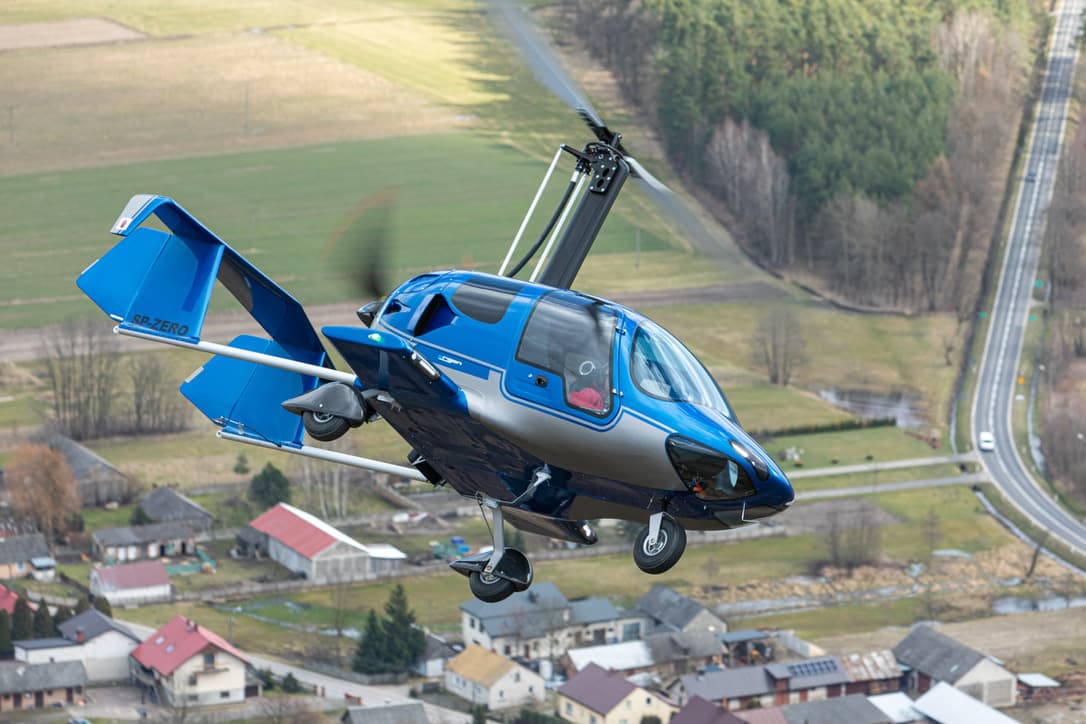
Gyrocopter vs Microlight
The cheap way to fly, and the way that flies more often
The short answer
These are the two affordable ends of British aviation, and people usually arrive at them from the same place: wanting to fly without spending what a certified aeroplane costs.
The microlight is cheaper to buy. That is not in dispute and we are not going to pretend otherwise. There is a deep second-hand market, and a new ARGON starts at £125,000.
The gyroplane is the one you will actually fly more often. In Britain the binding constraint is not money, it is weather - and the two aircraft behave very differently on a gusty Saturday.
Side by side
| Gyrocopter | Microlight | |
|---|---|---|
| Wing | A free-spinning rotor | A fixed wing, flex or three-axis |
| Can it stall? | No | Yes - and it is trained for |
| Rough air | Barely troubled by it | The reason many days are scrubbed |
| Runway needed | 100 m to take off, 60 m to land; grass is fine | Longer, and smoother |
| Crosswind | Lands into wind almost anywhere | More limiting |
| Purchase price | From £125,000 new | Considerably less, new or used |
| Licence | PPL(G) - 40 hours | NPPL(M) - its own syllabus |
| Hangar space | Rotor folds; small footprint | Small, flex-wing folds too |
The runway line is the one people check first, and those two figures are from the ARGON GTL's flight manual at its full 600 kg rather than from a brochure - how much runway a gyrocopter needs sets out where they come from and what doubles them.
The difference that decides it
A microlight flies on a wing. A gyroplane flies on a rotor that the air spins as the aircraft moves forward - autorotation, from takeoff to touchdown. Everything below follows from that.
It cannot stall. A fixed wing asked for more lift than the airflow can give will stop flying. A rotor turned by the air through it keeps turning as long as the aircraft is moving, including in a steep descent with the engine off. Fly a gyroplane too slowly and it descends, under control, rather than dropping.
Rough air troubles it far less. A gyroplane's rotor disc carries a high loading and simply cuts through gusts that throw a light fixed wing about. Anyone who has flown a flex-wing on a thermic afternoon knows the difference. This is the practical answer to the question of how many days a year you fly.
It lands on almost nothing. Flown properly a gyroplane touches down close to one spot and rolls a couple of metres, into any reasonable wind - a farm strip, a beach, a field. Thirty-five seconds, filmed at our partner school:
Where the microlight wins
Money, plainly. Both new and used, a microlight costs a great deal less than a factory-built gyroplane, and the used market is far larger. If the budget is the deciding factor, the decision is already made and no amount of rotor physics changes it.
The licence is a shorter road. The NPPL with a microlight rating (what the NPPL allows, against the PPL, is in NPPL vs PPL) is its own syllabus and generally quicker to reach than the 40-hour PPL(G). All four routes - aeroplane, microlight, gyroplane and helicopter - are compared on hours, medical and cost in the cheapest way to learn to fly in the UK.
And a flex-wing is a particular pleasure. Open air, feet in the breeze, nothing between you and the view. A gyroplane with an enclosed carbon cabin is a different sort of flying - warmer and quieter, but not the same thing.
What it costs to run
Closer than the purchase prices suggest. Both run on ordinary unleaded petrol rather than avgas, which is most of the running cost of any light aircraft. An ARGON burns about 23 litres an hour at cruise, coming to roughly £35 an hour in fuel, oil and scheduled servicing. The full picture is in our guide to what a gyrocopter costs to buy and run.
So which should you buy?
If the budget is tight, buy the microlight. It will get you flying sooner and for less, and that matters more than any specification.
If you can reach a gyroplane, buy it for the days. Britain gives you a limited number of flyable weekends a year, and the aircraft that is comfortable in gusts, indifferent to a short strip and incapable of stalling will use more of them. Over five years that is the difference between a hobby you keep and one you sell.
If the comparison you are really weighing is against a helicopter instead, that one turns on a single question - do you need to hover.
Frequently asked questions
What is the difference between a gyrocopter and a microlight?
A microlight flies on a fixed wing, either a flex-wing under a trike or a three-axis aeroplane. A gyrocopter flies on a rotor that is turned by the air passing through it rather than by the engine. That one difference drives everything else: a gyroplane cannot stall, it is far less troubled by rough air, and it needs a fraction of the runway.
Is a microlight cheaper than a gyrocopter?
To buy, yes - usually by a wide margin, and there is a large second-hand market. A new ARGON starts at £125,000. Running costs are closer than the purchase prices suggest, because both burn ordinary unleaded petrol rather than avgas.
Which handles wind and rough air better?
The gyroplane, and it is not close. A gyroplane's rotor is in autorotation at all times and its disc loading shrugs off gusts that make a flex-wing unpleasant and sometimes unflyable. In a country where weather cancels more lessons and more flights than anything else, that is the difference between an aircraft you use and an aircraft you look at.
Do you need a licence to fly a gyrocopter in the UK?
Yes. A microlight is flown on the NPPL with a microlight class rating; a gyroplane needs the PPL(G), which is 40 hours of supervised training with at least 15 dual and 10 solo in gyroplanes, five written exams and a flight test. Hours in one do not convert straight across, though supervised training in any flying machine can count towards the PPL(G) total.
How much runway does a gyrocopter need?
About 100 metres to take off and 60 to land, on the ARGON GTL's own flight-manual figures at 600 kg. A microlight needs a longer, smoother run and is more constrained by crosswind, and a gyroplane flown properly touches down almost on one spot and rolls a couple of metres into any reasonable wind. That is what makes the gyro the better aircraft for farm strips and unprepared ground - though wet or unmown grass can easily double the take-off distance for either of them.