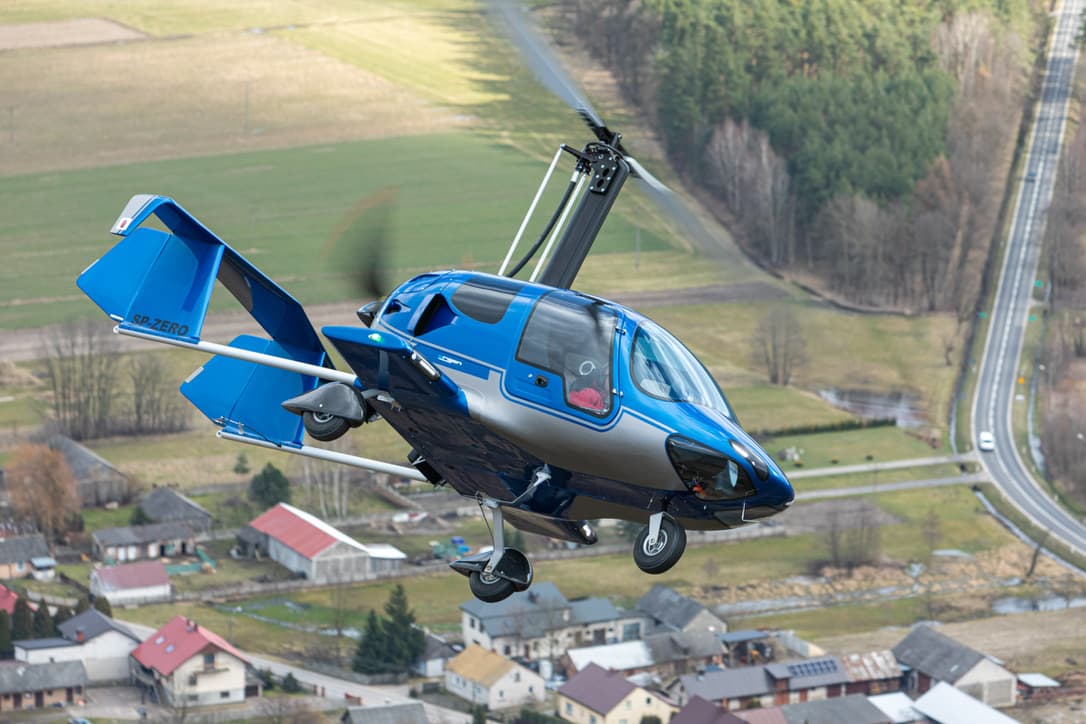
How to Fly a Gyroplane
The controls, who sits where, and what happens at each end of the flight.
A stick, rudder pedals and a throttle - and no collective, because the engine drives only the propeller while the rotor is turned by the air flowing up through it. Everything else on this page follows from that, including why either seat can fly the aircraft and why an engine failure ends in a landing.
Every figure below is from the flight manual of the ARGON GTL, Issue 1 of 29 November 2024, with the chapter named so you can check it. Argo Aero UK Ltd sells the ARGON in Britain for Manufaktura Lotnicza and trains people on it, so read this as an interested party describing its own aircraft - the numbers are the manufacturer's rather than ours.
How are the controls of a gyroplane arranged?
There are three: a control stick, rudder pedals and a throttle, arranged as they are in an aeroplane. The stick tilts the whole rotor head, which is how the aircraft is pitched and rolled. The pedals work the rudder in the air and steer the nosewheel on the ground. The throttle sets engine power, and the engine drives only the propeller.
What matters is what is not there. No collective lever, because there is no powered rotor to raise or lower the pitch of. No anti-torque pedal to hold against engine torque, because the rotor is not driven and produces none. Nothing to balance against anything else: in a helicopter, raising the collective yaws the nose, which moves the pedals, which changes the power, which moves the rotor rpm, and the pilot holds all four at once. In a gyroplane the rotor turns because air flows up through it, and it keeps doing that without being asked.
Before every flight the manual has the pilot check the free movement of the flight controls, naming the rudder pedals, the nosewheel and the elevator - chapter 4.3. It is one line on a walkaround that takes about fifteen minutes.
Which seat does the pilot sit in?
Either one, and the ARGON GTL's flight manual says so in as many words at chapter 1: the pilot's seat is not specified by Manufaktura Lotnicza or by aviation regulations, and the pilot in command may sit in the left or the right seat. This is worth stating plainly because it is often said otherwise - that European gyroplanes are flown from the right, or that the left is the command seat. For this aircraft it is written down, and the answer is neither.
Both ARGONs seat two side by side with dual controls, which is the arrangement a flying instructor works from and the reason these are the aircraft people learn on. What the manual does insist on, at chapter 4.3, is the arithmetic of flying alone: secure suitable ballast on the floor in front of the empty seat, fasten that seat's belt, close its door - and take the ballast out again before carrying a passenger. An empty seat moves the centre of gravity out of the envelope the aircraft was tested in.
Getting off the ground
A gyroplane rotor has to be turning before the aircraft will fly, and it is not driven in flight, so it is spun up on the spot first. The pre-rotator does that against the brakes; the manual's operating limits require at least 310 rotor rpm before the take-off run, and the normal range once flying is 200 to 420 rpm, with a red warning above that - chapter 2.2 and 2.3.
Then the brakes come off and the aircraft accelerates. It leaves the ground at 85 km/h indicated, which is 46 knots, after a run of about 100 metres; 280 metres is the figure for clearing a 15-metre obstacle, all from chapter 5.4 at 600 kg and sea level. A hundred metres of firm level ground is a farm strip or a short club runway rather than an aerodrome, which is most of the point of owning one.
How do you land a gyroplane?
You fly a normal approach and the aircraft stops almost where it touches. The ARGON GTL's final approach speed is 90 km/h indicated with two people aboard and 80 km/h with one - chapter 5.3 - and the landing roll is 60 metres, 180 metres in total over a 15-metre obstacle.
The rotor needs nothing during any of this. It is in autorotation on the approach exactly as it was in the cruise, so there is no transition to make and nothing to spool up or wind down; that is the whole difference from a helicopter, where autorotation is the emergency the pilot trains for. And because the ARGON GTL's minimum speed is 50 km/h indicated - 27 knots, chapter 2.2 - landing into any sort of headwind leaves very little groundspeed at touchdown. Into twenty knots of wind the aircraft is doing about seven over the ground when the wheels arrive.
It is not a vertical landing and we are not going to call it one. It is a steep approach that ends in a few metres of roll, which answers the same practical question for a small field without asking the pilot to hover - the skill that takes the hours, and where a helicopter's worst flight regimes live.
What the rotor is doing all this time
Turning on its own, from the air passing up through the disc as the aircraft moves. That is autorotation, and in a gyroplane it is not a manoeuvre but the normal state of the machine in every phase of flight. It is why there is no collective to hold, why the aircraft cannot stall, and why the flight manual can give an engine-failure procedure at section 3.13 that ends in a landing rather than in a parachute.
It is also why the speeds look unusual. The ARGON GTL is permitted 175 km/h indicated in strong turbulence and has a never-exceed speed of 207 km/h, with the red line on the airspeed indicator painted at 210 - chapter 2.2 and 2.3. A rotor already in autorotation is an unusually settled thing to sit under, which is the reason gyroplane pilots fly on days when light aeroplanes stay in the hangar.
What this does not tell you
How hard any of it is to learn. The controls are simple and the flying is not the difficult part - what takes practice is handling the rotor on the ground in wind, before the aircraft is going anywhere. That question has its own answer, with the forty hours and the thirty-eight exercises in it, and what training actually involves is set out separately.
Common questions
- How are the controls of a gyroplane arranged?
- A control stick, rudder pedals and a throttle, arranged as they are in an aeroplane. The stick tilts the rotor head for pitch and roll; the pedals work the rudder, and on the ground the nosewheel. There is no collective lever and no anti-torque pedal to balance, because the engine drives only the propeller while the rotor is turned by the air flowing up through it. The ARGON GTL and the ARGON 915, which Argo Aero UK sells in Britain for Manufaktura Lotnicza, both seat two side by side with dual controls, so either seat can fly the aircraft. The flight manual's pre-flight check, chapter 4.3, has the pilot check the free movement of the controls before every flight, the rudder pedals and nosewheel among them.
- Which seat does the pilot sit in on a gyroplane?
- Either. The ARGON GTL's flight manual says so in as many words at chapter 1: the pilot's seat is not specified by the manufacturer or by aviation regulations, and the pilot in command may sit in either the left or the right seat. That is worth knowing because it is often said otherwise. What the manual does require, at chapter 4.3, is that a pilot flying alone secures suitable ballast on the floor in front of the empty seat, fastens that seat's belt and closes its door - and removes the ballast before a two-person flight.
- How do you land a gyroplane?
- You fly a normal approach, trade speed for a steep descent, and the aircraft stops almost where it touches. In the ARGON GTL the final approach speed is 90 km/h indicated for two people aboard and 80 km/h for one, from chapter 5.3 of its flight manual, and the landing roll is 60 metres - 180 metres in total over a 15-metre obstacle. The rotor does not have to be managed: it is in autorotation throughout, as it is in every other phase of the flight, so there is nothing to spool up or wind down. Land into wind and very little groundspeed is left at touchdown, which is why a gyroplane fits into a field that no aeroplane of the same size could use.
- How slowly can a gyroplane fly?
- The ARGON GTL's minimum speed is 50 km/h indicated, 27 knots, from chapter 2.2 of its flight manual. A gyroplane has no stall speed, because the rotor is turned by the airflow through it rather than by forward speed over a wing, so flying slowly does not threaten the lift the way it does in an aeroplane. The airspeed indicator's green arc starts at 30 km/h for that reason.
- What does the pilot do if the engine stops?
- Fly the aircraft down and land it. The rotor of a gyroplane is already autorotating - that is its normal state in every phase of flight, not an emergency manoeuvre - so an engine failure costs thrust and not lift. The ARGON GTL's flight manual gives the procedure at section 3.13, and it ends in a landing. There is no height below which it stops working, which is the difference between a gyroplane and an aircraft that depends on a parachute.
- Is a gyroplane flown like a helicopter?
- No, and the difference is one lever. A helicopter pilot holds a cyclic, a collective and anti-torque pedals, and all three interact with rotor rpm: raise the collective and the nose yaws, so the pedals move, and the power changes, so the rpm moves. A gyroplane pilot holds a stick, pedals and a throttle, and nothing has to be balanced against anything else. The one thing a helicopter does that a gyroplane cannot is hover.
The aircraft described here is the ARGON GTL, and its flight manual is published by Manufaktura Lotnicza at argo.aero. What it costs and what is in stock is on gyrocopters for sale.