

Are Gyrocopters Hard to Fly?
The flying is forgiving. The ground is where the skill is.
Gyrocopters are easier to fly than helicopters and harder to operate than they look. In the air the aircraft is forgiving: a gyroplane cannot stall and cannot spin, it lands slowly and steeply, and an engine failure costs it thrust rather than lift, because the rotor is already autorotating. The demanding part is on the ground - bringing the rotor up to speed and holding it steady in wind - and that is why the UK licence is 40 hours across a 38-exercise syllabus rather than a weekend course. Almost everybody who starts finishes.
That is the whole answer. The rest of this page is where each part of it comes from. It is written by Argo Aero UK, the United Kingdom dealer for Manufaktura Lotnicza, from the CAA syllabus and from instructors who teach the course - so treat the last section as an interested party talking about its own aircraft, and check the numbers, which are all public.
What the aircraft does for you
These are structural rather than encouraging. They are true of the machine whatever kind of day you are having.
- It cannot stall. The rotor is turned by the air passing through it, so asking for too much lift too slowly - the mistake that kills more light aeroplanes than anything else - simply is not available to you.
- It cannot spin, for the same reason.
- The landing is slow and steep rather than fast and flat, which means a short strip is forgiving and a misjudged approach is corrected rather than survived.
- An engine failure is not an emergency configuration. The rotor is already in autorotation, so it keeps turning exactly as it was and you glide down and land.
- Rough air is easier than in a light aeroplane. The rotor disc carries a high loading and cuts through the gusts that make an aeroplane unpleasant.
Put together, that removes the two ways light aeroplanes are most often lost - the stall and the spin - not by training them out of you, but by not offering them.
What the aircraft asks back
Here is the part that gets left out, and it is the honest answer to the question in the title.
- The rotor on the ground. This is the real skill and the one nobody warns you about. Before the aircraft flies, the rotor has to be brought up to speed and kept under control while the wind tries to lift one blade and drop the other. It is taught from the first lesson and it is why the licence takes the hours it does.
- The take-off sequence. Pre-rotate, release, accelerate, let the rotor take the weight - a specific order that becomes automatic and is clumsy until it does.
- Being gentle. A gyroplane responds to smooth inputs and punishes fighting it. People who arrive from other aircraft sometimes take longer than people who arrive from nothing, because they have habits to unlearn.
A gyroplane is easy to fly and takes practice to operate. That is a real distinction and it is the one that decides how your first few lessons feel.
Against a helicopter
One word: the hover. Holding a helicopter still over one point is the hardest thing to learn in light aviation and it is where most of the hours go - the CAA minimum for a helicopter licence (PPL(H)) is 45 hours and the British average is somewhere between 60 and 90.
A gyroplane does not hover, so that skill never arises - and neither does the £30,000 difference between the two licences. We sell helicopters too, so this is not a slight on them: if you need to hold still above one point, nothing else will do and it is worth what it costs.
What the course actually asks
The UK licence is 40 hours across a 38-exercise syllabus, at least ten hours of it solo, five theory papers and a skills test. Those are the CAA's figures, set out in Standards Document 44 - not a school's estimate. Worth knowing: first solo comes about two thirds of the way through the exercises rather than at the end - by then you have flown thirty of them, including every emergency.
Four of those exercises are engine-off landings, all before your first solo. You practise arriving in a field until it is ordinary, which tells you something about how the training is arranged.
For what it is worth on the safety question: Manufaktura Lotnicza reports no fatal accident across the ARGON fleet, now more than 150 aircraft flying and well past 27,350 hours between them. That is the manufacturer's statement rather than ours, and it is about one type, not about gyroplanes in general.
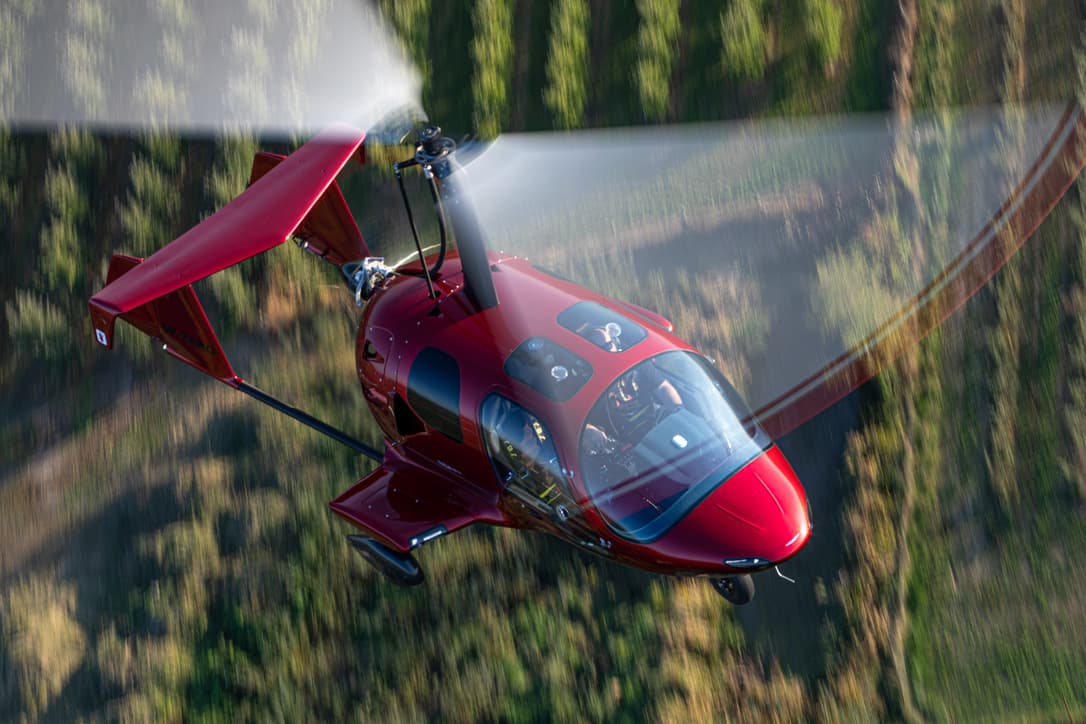
That is what precision looks like by the end - the aircraft arriving where the pilot said it would, slowly and steeply, in a space no aeroplane would consider.
Who finds it hardest
Not the people with no experience. Fixed-wing pilots sometimes take longer, because a gyroplane rewards patience and smooth inputs and they arrive with reflexes built around a wing. Nothing is wrong with either - instructors see it constantly - but it is worth knowing before you assume a PPL puts you ahead.
And nobody is held back by the weather being difficult here, which is a separate problem entirely: British weekends turn 40 hours into six months or a year, which is why our own course runs in the Algarve and takes about four weeks.
The short answer
If you can drive a car attentively and take instruction without arguing with it, you can fly a gyroplane. Almost everybody who starts finishes.
What separates the people who enjoy the course from the people who find it a grind is not talent. It is whether they expected the rotor handling, or thought they were buying forty hours of the view.
Frequently asked questions
Are gyrocopters hard to fly?
Easier than a helicopter, different from an aeroplane, and harder than the marketing suggests. The flying itself is forgiving - a gyroplane cannot stall or spin, it lands slowly and steeply, and an engine failure costs thrust rather than lift. The demanding part is on the ground: handling the rotor before and after flight, in wind, is the real skill, and it is why the UK licence takes 40 hours rather than a weekend.
Are gyrocopters easy to fly?
In the air, largely yes, and the reasons are structural rather than encouraging: the stall and the spin are not available to the aircraft, so two of the ways pilots get into trouble are removed by design. What is not easy is the rotor handling on the ground and the take-off sequence, and no school will shorten those because they are the skill you are paying for.
Is a gyroplane harder to fly than a helicopter?
No, and the difference is one word: the hover. Learning to hold a helicopter still over one spot is the hardest thing in light aviation and is where most of the hours between the 45-hour minimum and the 60 to 90 people actually fly are spent. A gyroplane does not hover, so that entire skill - and the £30,000 gap between the two licences - does not arise.
How long does it take to learn to fly a gyroplane?
The UK licence is 40 hours across a 38-exercise syllabus set out in CAA Standards Document 44, with at least ten hours solo, five theory papers and a skills test. Most people go solo about two thirds of the way through the exercises, not at the end. Flown at British weekends the weather usually stretches 40 hours into six months or a year; flown intensively it is about four weeks.
Do I need any flying experience to start?
None at all, and holding another licence is not necessarily an advantage. Fixed-wing pilots sometimes take longer at first because a gyroplane rewards smooth, patient inputs and they arrive with habits suited to a wing. On the medical, the UK is lighter than people expect: for the PPL(G) you can self-certify with a CAA medical declaration rather than hold a certificate. Training in Portugal is the stricter case - Portuguese rules require a Class 2, so arrange that before you travel.
And the legal question underneath it: do you need a licence to fly a gyrocopter - yes, with one exception worth using.